Gondogoro Peak Climb
A first Karakoram summit at the head of the Gondogoro glacier, above Hushe
Last updated: · Reviewed by Javeed Iqbal, Founder
Elevation
5,650m
Difficulty
Moderate
Duration
16 Days
Best Season
Jul to Aug
Gondogoro Peak (5,650m): a first Karakoram summit above Hushe
Gondogoro Peak is the summit many people choose for their first climb in the Karakoram. It rises to about 5,650 metres at the head of the Gondogoro glacier, right beside the Gondogoro La, and the route is mostly roped glacier walking and easy-angled snow, with three to five pitches of fixed rope on a narrowing ridge to the top. There is no peak royalty, no liaison officer and no previous mountaineering experience required, only fitness, a head for altitude and a day of practice with crampons and a jumar. In return you get a summit view of Masherbrum, Chogolisa, Gasherbrum I and Laila Peak, and on a clear morning a distant look at K2. This page covers where the peak is, how the climb goes, how to combine it with the Gondogoro La and how we run it.
Where is Gondogoro Peak?
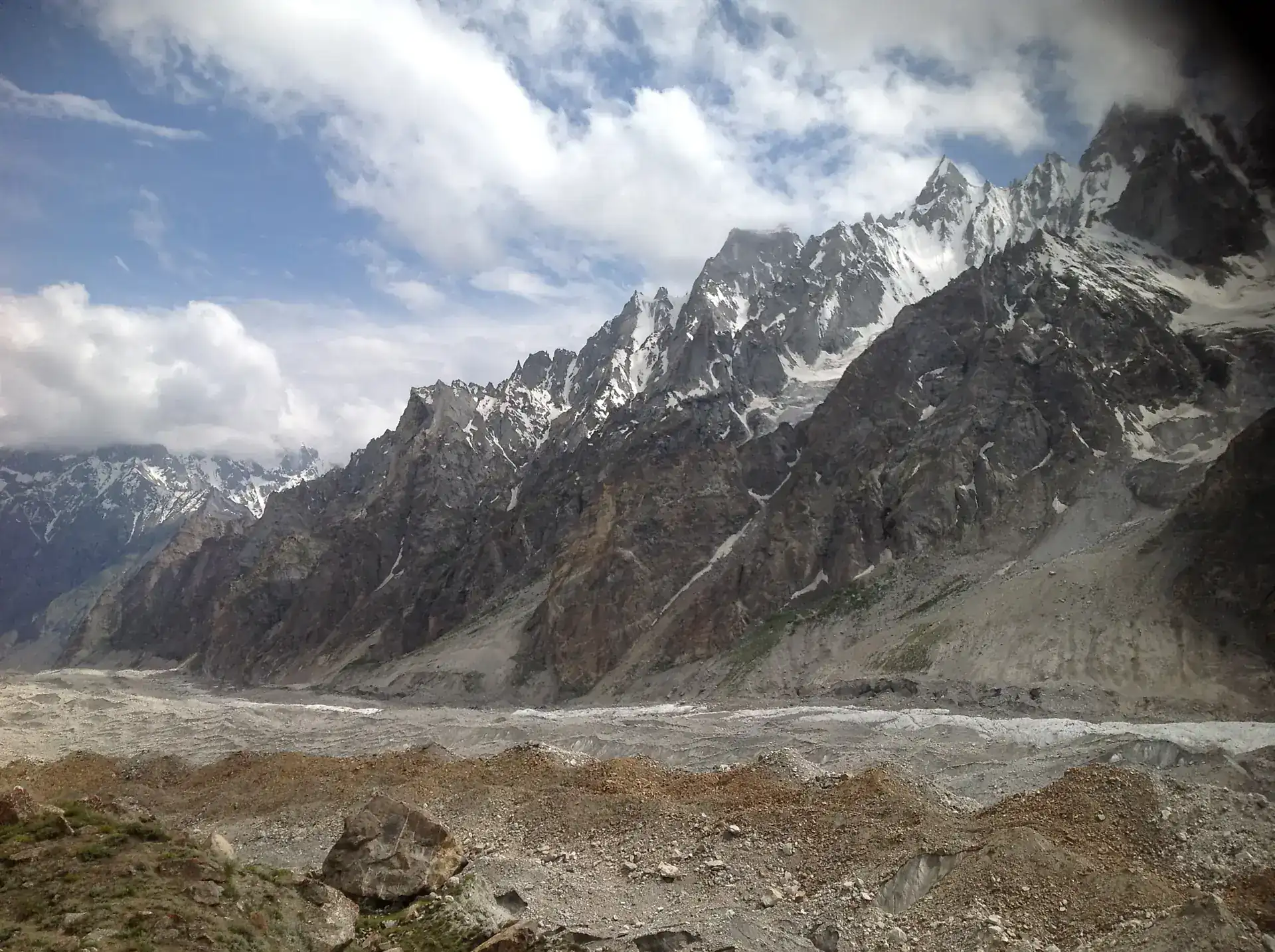
Gondogoro Peak stands at the head of the Gondogoro glacier above the Hushe valley, in Ghanche district of Gilgit-Baltistan, inside Central Karakoram National Park. The Gondogoro La, the 5,585 m pass between Hushe and the Baltoro, lies just below and beside the summit; from the top the pass looks like a flat snowfield at your feet. The road ends at Hushe, at about 3,050 m, reached by jeep from Skardu through Khaplu. The name causes some confusion. There is only one peak sold as Gondogoro Peak. Gondogoro Ri, at about 6,810 m, is a different and far higher mountain, and the Gondogoro La is a pass, not a peak.
How high is Gondogoro Peak?
The peak has never been properly surveyed. Most sources, including SummitPost and the major trekking-peak operators, give 5,650 m, and that is the figure we use. The 1987 British team that reported their ascent in the American Alpine Journal called it "c. 5,700 m", and one local operator says 5,750 m. You will not find a source for the 5,800 or 5,900 m figures that sometimes appear in marketing copy. Whichever number is right, it is about 65 m higher than the Gondogoro La.
How hard is Gondogoro Peak?
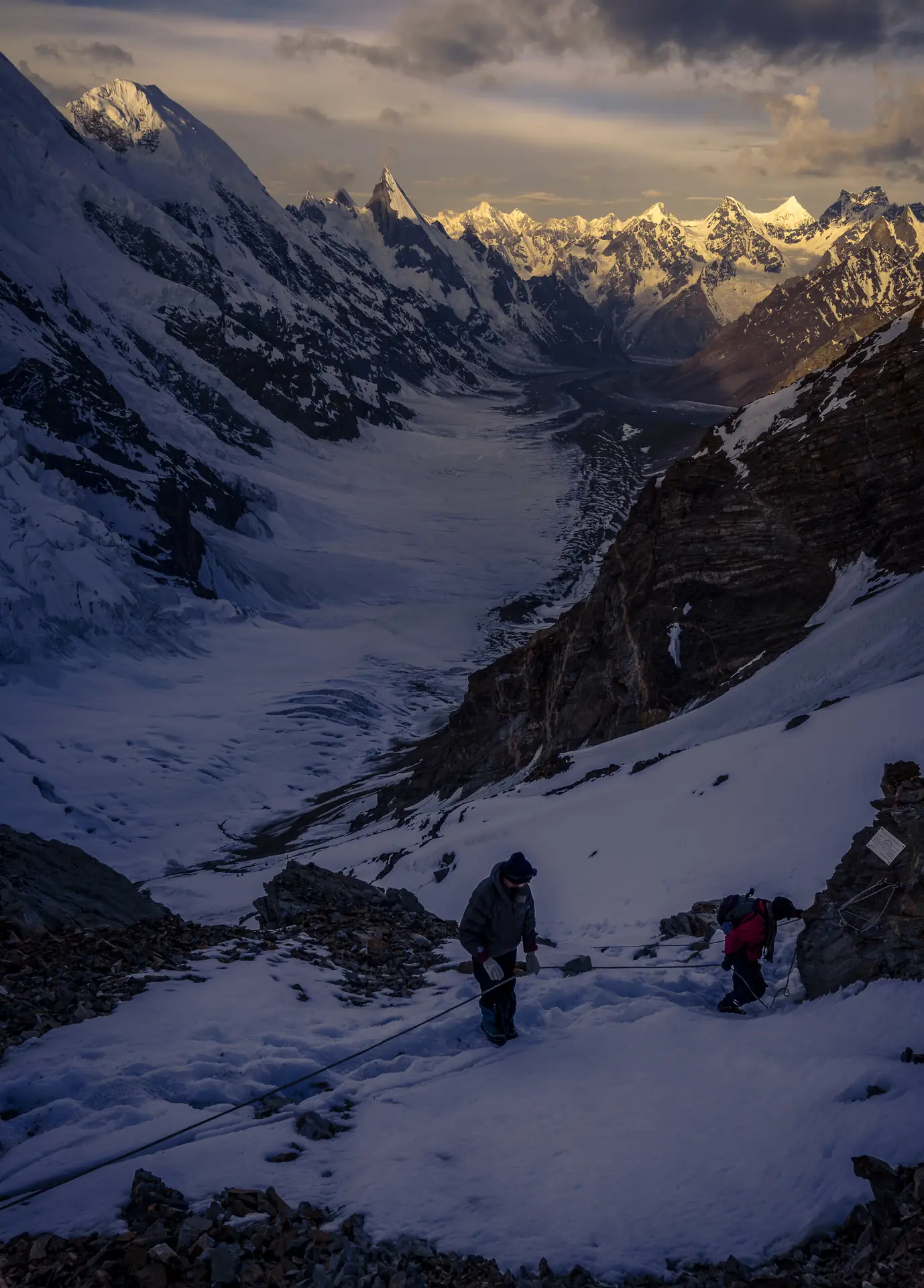
Gondogoro Peak is a trekking peak, graded PD minus (peu difficile, a little difficult) by the UK operator that has run it since the 1980s. The climb has three parts: a scramble up moraine from camp to the snowline, roped glacier travel up easy-angled snow with a few crevasses, then steeper snow of 30 to 45 degrees on a narrowing ridge to the summit. The last 100 to 200 m is the steepest, and our guides fix three to five pitches of rope there; you climb it on a jumar and come down by abseil or on a safety line. Altitude, not technique, is what makes it hard. If you are fit and have trekked at 4,000 to 5,000 m before, you can do it. If you want something steeper afterwards, Laila Peak is right across the glacier.
Summit day
Summit day starts between midnight and 1 am from Khuspang, the base camp, so the snow is frozen hard on the way up. Most groups reach the top around sunrise or early morning, which is also when the view is clearest, and are back in camp by mid-morning or lunchtime. Some teams then walk on down to Dalsampa the same afternoon, which makes a 12-hour day. A high camp a few hundred metres above Khuspang can shorten the climb if conditions or the group need it.
The approach and camps
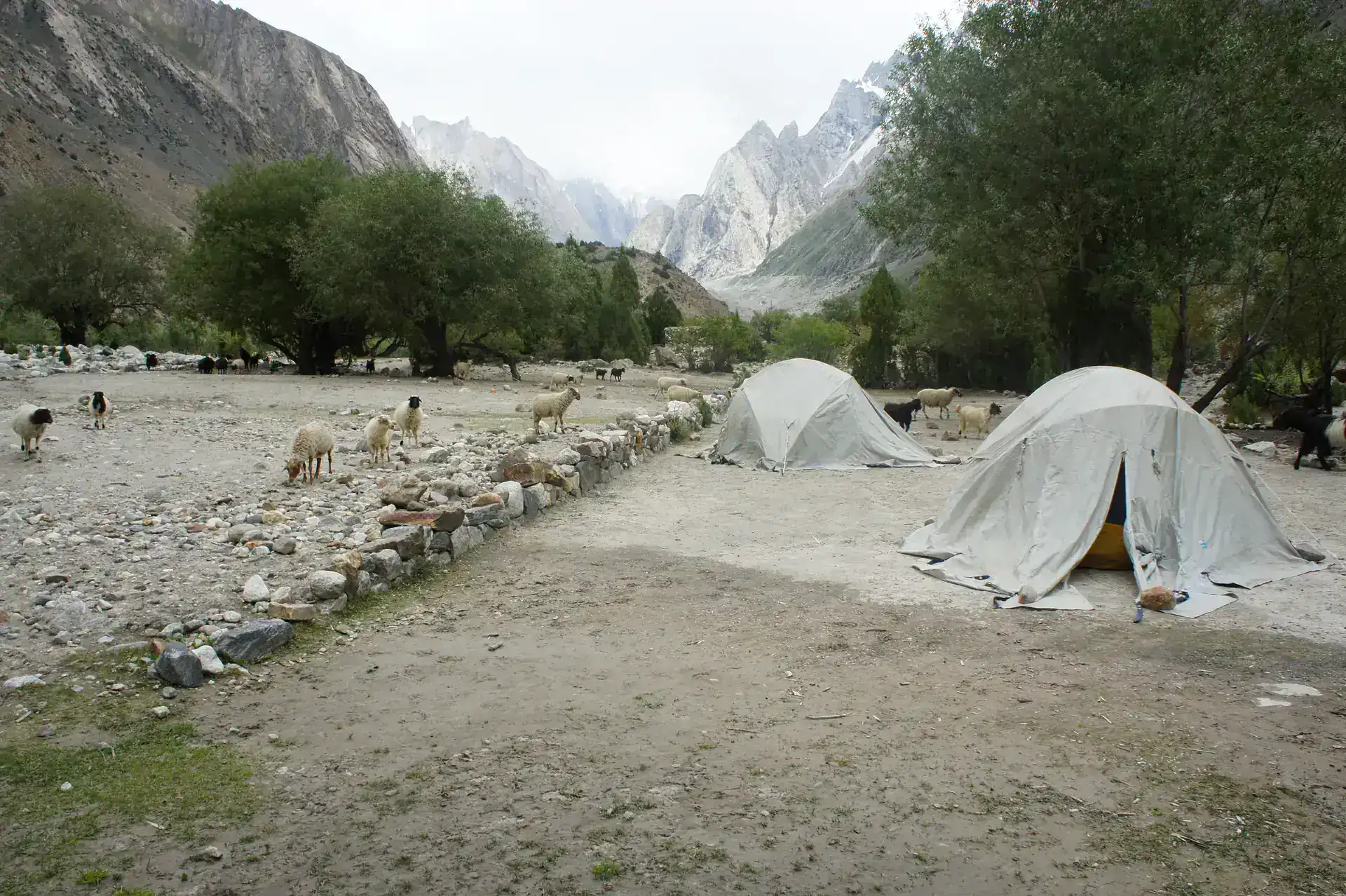
From Hushe the trail goes up to Saicho, a camp among willows at about 3,350 m where the Charakusa valley, home of K6 and K7, meets the Gondogoro. The next stages pass the summer herders' huts at about 3,700 m and reach Dalsampa at about 4,150 m, a grassy meadow with small lakes opposite the Masherbrum icefall. Between them the path crosses a gully at the glacier edge known for stonefall, which we pass early in the day. From Dalsampa a five-hour walk across the glacier, under the face of Laila Peak, reaches Khuspang, the base camp for the climb at about 4,600 to 4,700 m. It is a grassy terrace by a meltwater pool with the summit headwall above. We spend a full day there on rope skills before the climb.
Combine it with the Gondogoro La and K2 Base Camp
Khuspang is also the last camp before the Gondogoro La on the Hushe side, so the peak fits neatly onto the end of a K2 Base Camp trek. You walk up the Baltoro to Concordia and K2, cross the La from Ali Camp at dawn with K2, Broad Peak and the Gasherbrums behind you, then rest a day at Khuspang and climb the peak before walking out to Hushe. That version takes about 23 days. British parties have done exactly this since at least 2000, and it means you arrive at the peak already well acclimatised.
Best time to climb Gondogoro Peak
Climbs run from June to September, and July and August are the usual window, the same season as the Gondogoro La crossing. Operator groups summit in July and early August; a student team from LUMS reached the top on 2 September 2021. A British party climbed it as early as May 1987 in deep spring snow, but that is not a season we sell.
A 16-day Gondogoro Peak plan
| Days | Plan | Sleeping altitude |
|---|---|---|
| 1 to 2 | Arrive in Islamabad, permit briefing; fly to Skardu | about 2,230 m |
| 3 | Jeep via Khaplu to Hushe | about 3,050 m |
| 4 | Acclimatisation walk above Hushe | about 3,050 m |
| 5 to 7 | Walk to Saicho, the Gondogoro huts, then Dalsampa | 3,350 m, 3,700 m, 4,150 m |
| 8 to 9 | Cross the glacier to Khuspang base camp; rope skills and rest day | about 4,600 to 4,700 m |
| 10 | Summit day, then down to Dalsampa | summit about 5,650 m, sleep 4,150 m |
| 11 | Spare weather day | - |
| 12 to 13 | Walk out via Saicho to Hushe | about 3,050 m |
| 14 to 15 | Drive to Skardu, fly to Islamabad | about 2,230 m, then Islamabad |
| 16 | Departure, or a spare day for a delayed flight | - |
Permits and cost
Pakistan charges no peak royalty below 6,500 m and assigns no liaison officer for peaks of this height, so Gondogoro Peak needs no climbing permit of its own. The Gondogoro glacier, however, is in a restricted zone. Foreign climbers need a trekking permit issued through a licensed operator, a licensed guide and the Central Karakoram National Park fee, and should apply for a mountaineering and trekking visa with an operator's sponsorship letter, because the Gondogoro route is on NADRA's list of restricted treks. Our Gondogoro Peak climb starts at $2,400 per person, Islamabad to Islamabad, with the permit, park fee, guides, porters, camps, meals and the fixed rope included.
What it takes, and who it suits
Gondogoro Peak suits fit trekkers who want to stand on a real Karakoram summit without previous climbing experience, and climbers using it as a step towards 6,000 m peaks such as Khosar Gang or Laila Peak. You should be comfortable on long trekking days at altitude; we teach the rope skills on the mountain. It is also a good way to add a summit to the Gondogoro La crossing for anyone already on the K2 trek.
Climbing History
1986
The first commercial trekking-peak trips
The first commercial trekking-peak trips
The British operator KE Adventure says its very first trekking-peak holiday, in 1986, climbed Gondogoro Peak from a base camp at Khuspang. No earlier ascent has been recorded.
1987
The earliest published ascent
The earliest published ascent
From 7 to 10 May, Dick Renshaw, Jon Tinker, Mark Miller, Simon Yates, Michael Searle and Craig Kentwell all climbed Gondogoro Peak, which they reported in the American Alpine Journal as about 5,700 m.
2000
Gondogoro La and the peak together
Gondogoro La and the peak together
British trekkers climbed the peak the day after crossing the Gondogoro La from the Baltoro, the combination that operators still sell today.
2021
First Pakistani woman on the summit
First Pakistani woman on the summit
On 2 September Saba Haleem of the LUMS Adventure Society reached the top with the veteran climber Rozi Ali, reported as the first Pakistani woman to climb Gondogoro Peak.
Gondogoro Peak Climb: Frequently Asked Questions
How high is Gondogoro Peak?
How high is Gondogoro Peak?
Gondogoro Peak is about 5,650 m high. That is the figure given by SummitPost, by the UK and Pakistani operators who run the climb and in most itineraries, and it is the one we use. The peak has never been formally surveyed, so other figures exist: the British climbers who reported an ascent in the American Alpine Journal in 1987 called it about 5,700 m, one local Hushe operator says 5,750 m, and one UK company's headline gives 5,695 m. There is no source for the 5,800 m or 5,900 m that sometimes appear in marketing. Either way it is a little higher than the Gondogoro La, the 5,585 m pass right beside it, and well below the 6,500 m threshold for peak royalty in Pakistan. Do not confuse it with Gondogoro Ri, a separate peak of about 6,810 m.
Is Gondogoro Peak technical?
Is Gondogoro Peak technical?
Gondogoro Peak is not very technical. The UK operator that has run it since the 1980s grades it PD minus, and SummitPost describes little technical difficulty or objective danger. The route has three parts: a scramble up moraine from camp to the snowline, roped glacier travel on easy-angled snow with a few crevasses, then a narrowing snow ridge of 30 to 45 degrees to the summit. Only the last 100 to 200 m is steep, and our guides fix three to five pitches of rope there, which you climb with a jumar and descend by abseil or on a safety line. You will use crampons, an ice axe, a harness, a jumar and a descender. The real challenge is the altitude and the early start, not the climbing, which is why the peak is a popular first summit in the Karakoram.
Do I need climbing experience for Gondogoro Peak?
Do I need climbing experience for Gondogoro Peak?
You do not need previous mountaineering experience to climb Gondogoro Peak, but you do need solid trekking experience at altitude. The ideal climber has done multi-day treks above 4,000 m, is fit enough for a summit day that starts around midnight, and has ideally worn crampons before. We spend a full day at Khuspang base camp teaching the skills you need: walking roped together on a glacier, using crampons and an ice axe on snow, climbing a fixed rope with a jumar and abseiling or descending on a safety line. Our guides stay with you on the rope throughout the climb. If you have never been above 4,000 m, we recommend a trek such as the Gondogoro La or a Hushe valley trek first, or adding extra acclimatisation days to the itinerary. Many people use Gondogoro Peak as their stepping stone to 6,000 m peaks.
Where is Gondogoro Peak?
Where is Gondogoro Peak?
Gondogoro Peak is at the head of the Gondogoro glacier above the Hushe valley, in Ghanche district of Gilgit-Baltistan, northern Pakistan, inside Central Karakoram National Park. It sits right beside the Gondogoro La, the 5,585 m pass that links the Hushe valley with Concordia and the Baltoro glacier; from the summit the pass looks like a flat snowfield just below you. The nearest village is Hushe, at about 3,050 m, reached by jeep from Skardu through Khaplu in about 5 to 7 hours. From Hushe the approach takes four days, via Saicho, the Gondogoro herders' huts and Dalsampa, to Khuspang base camp at about 4,600 to 4,700 m. Laila Peak, Masherbrum and Chogolisa all rise around the same glacier, so the walk in is one of the most spectacular in the Karakoram.
Can you see K2 from Gondogoro Peak?
Can you see K2 from Gondogoro Peak?
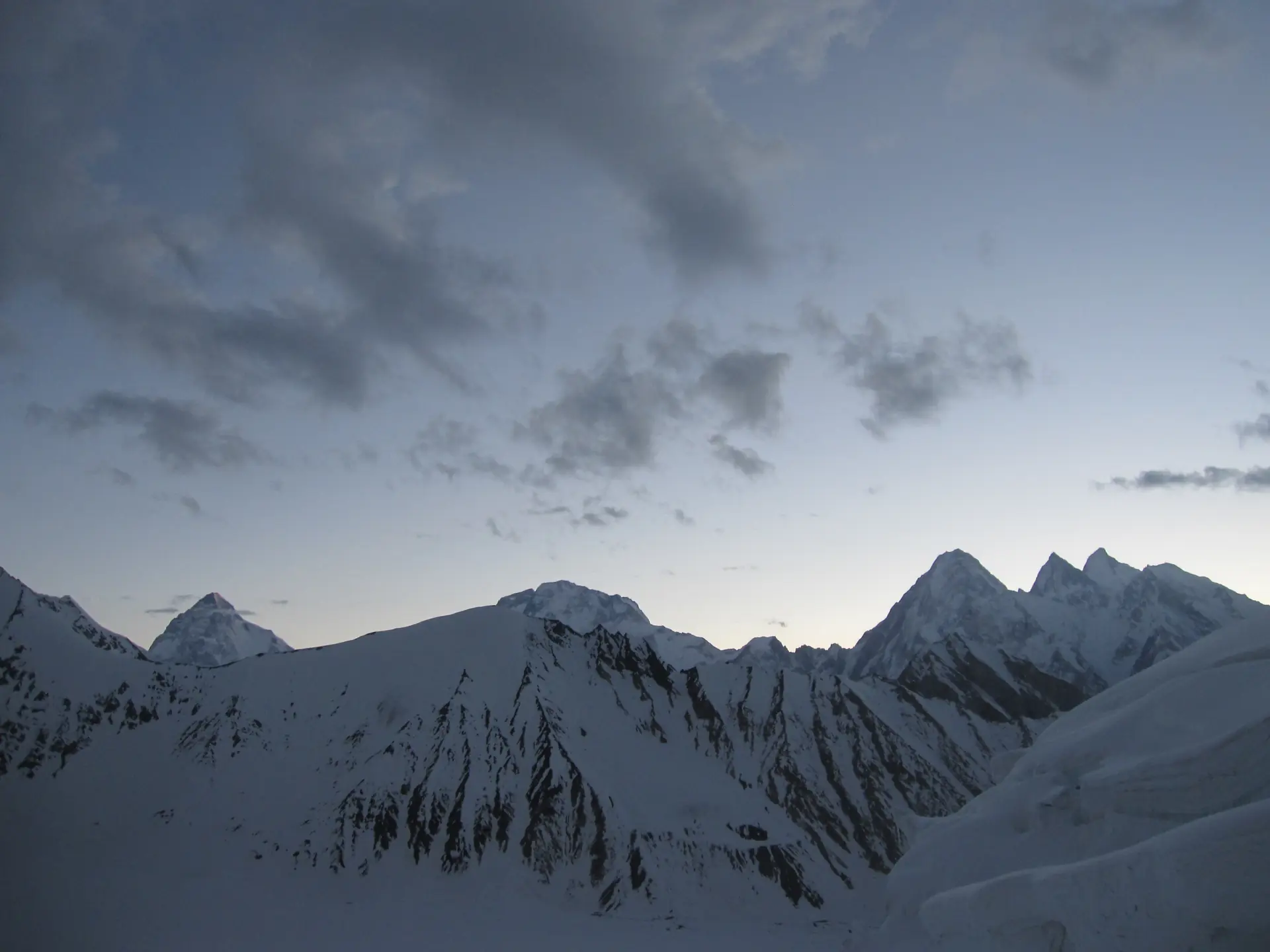
On a clear day you can see the summit of K2 from Gondogoro Peak, but only as a distant view. The closer panorama from the top takes in Masherbrum, Chogolisa, Gasherbrum I, also called Hidden Peak, Trinity Peak and Laila Peak, with the Gondogoro glacier below. The famous close-up view of K2, Broad Peak and the Gasherbrums in one sweep is from the Gondogoro La itself, the pass right beside the peak, which is one reason many climbers combine the two. If you approach from the Baltoro side as part of a K2 Base Camp trek, you cross the La at dawn with that view behind you, rest a day at Khuspang and then climb the peak. If you climb from Hushe only, you can walk up towards the La from Khuspang for the view, conditions permitting.
Do you need a permit to climb Gondogoro Peak?
Do you need a permit to climb Gondogoro Peak?
There is no peak royalty for Gondogoro Peak and no liaison officer, because Pakistan only charges royalty and assigns liaison officers for peaks above 6,500 m. The area around it does need a permit. The Gondogoro glacier is in a restricted zone, so foreign climbers need a trekking permit issued through a licensed Pakistani operator, a licensed guide and the Central Karakoram National Park fee, and the operator completes the formalities with the Ministry of Tourism before you head north. Because the Gondogoro route is on NADRA's list of restricted treks, you should apply for a mountaineering and trekking visa with the operator's sponsorship letter rather than a tourist visa, and allow about four weeks for it. All permits and park fees are included in our price, so you do not have to pay anything at a checkpost.
How many days does the Gondogoro Peak climb take?
How many days does the Gondogoro Peak climb take?
Our Gondogoro Peak climb from Hushe takes 16 days from Islamabad to Islamabad. That allows two days to reach Skardu, a day's jeep to Hushe, an acclimatisation day, four days walking in via Saicho, the Gondogoro huts and Dalsampa to Khuspang, a rope-skills day, summit day, a spare weather day, two days walking out and two days back to Islamabad, plus a spare day in case the Skardu flight is delayed. UK operators run a similar trip in 14 to 15 days with less spare time. If you combine the peak with the K2 Base Camp trek and a crossing of the Gondogoro La, the whole trip takes about 23 days, and you reach the peak already well acclimatised from the Baltoro. Tell us which version you want and we will plan the dates around it.
How much does it cost to climb Gondogoro Peak?
How much does it cost to climb Gondogoro Peak?
Our Gondogoro Peak climb costs from $2,400 per person, Islamabad to Islamabad, over 16 days. That includes the restricted-zone trekking permit and the Central Karakoram National Park fee, the jeep from Skardu to Hushe and back, porters, a licensed guide and climbing guides for summit day, tents and camping equipment, all meals on the trek and the climb, and group climbing gear including the fixed rope. It does not include international flights, travel insurance, personal climbing equipment such as boots, crampons, harness and jumar, or personal expenses. Because the peak is below 6,500 m there is no royalty to add. Combining the climb with the K2 Base Camp trek and the Gondogoro La costs more because the trip is longer, so contact us for a quote with exact dates and group size.
What's Included
Not Included
Ready for Your Next Adventure?
Join our community of explorers and discover the journey of a lifetime. Our expert team is ready to help you plan your perfect expedition.