Nangma Valley Trek
Hushe Valley, Ghanche, Gilgit-Baltistan
Last updated: · Reviewed by Javeed Iqbal, Founder
Elevation
4,300m
Difficulty
Moderate
Duration
3 Days
Best Season
Jun-Sep
Nangma Valley Trek: the short route into Pakistan's Yosemite
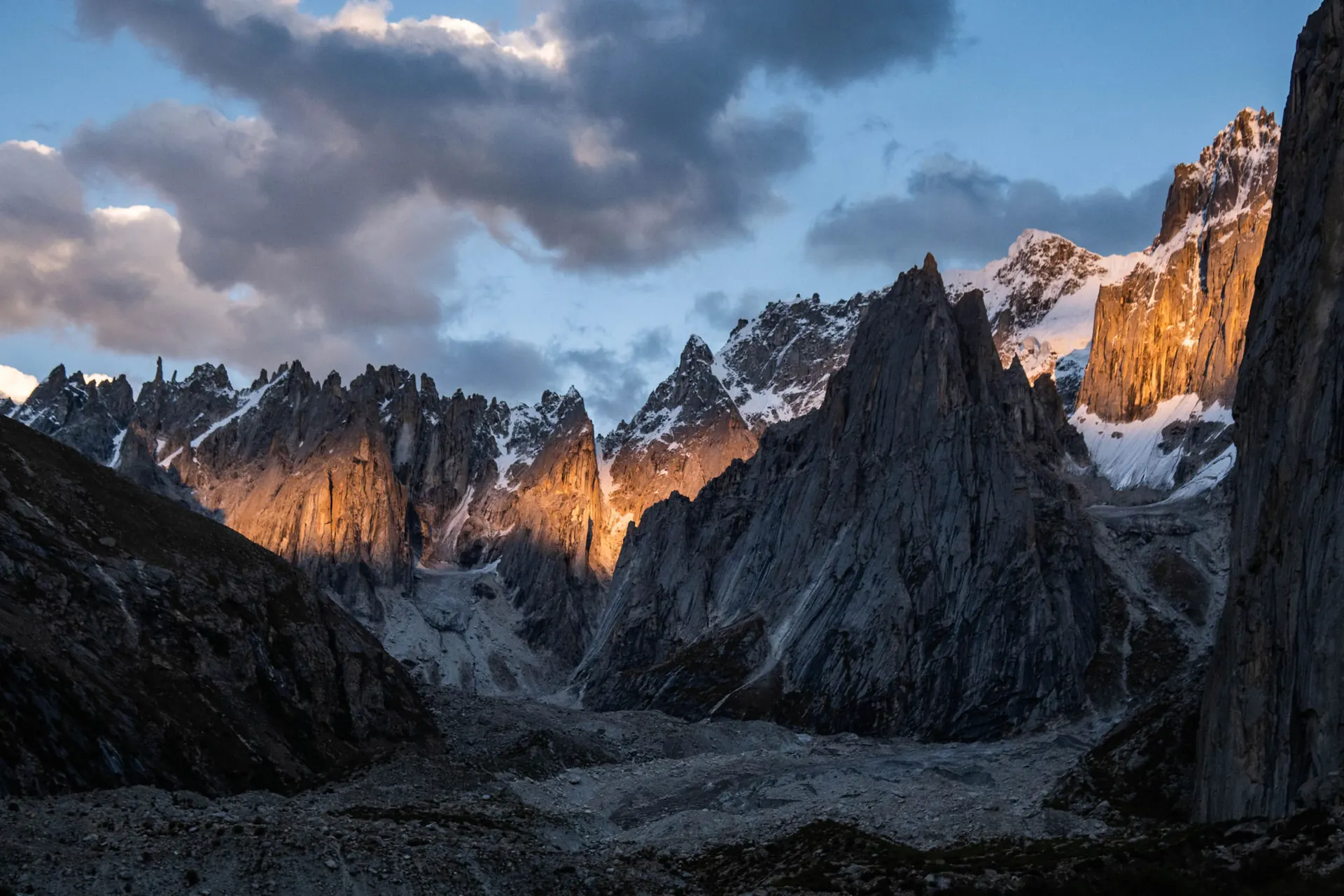
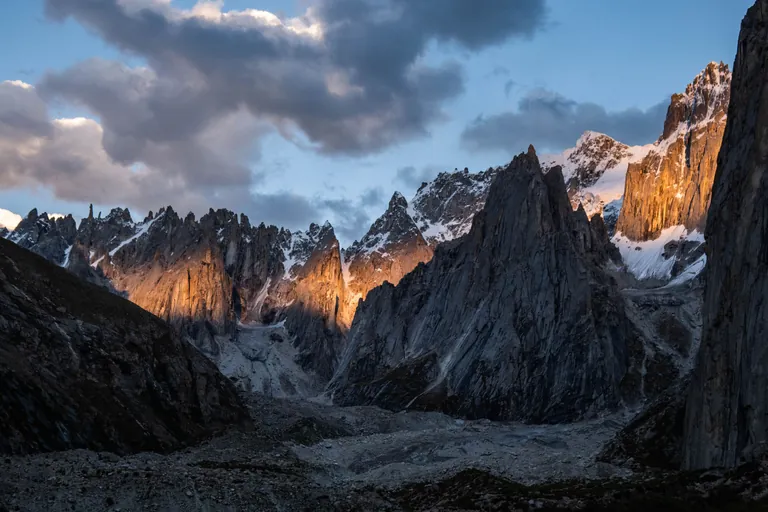
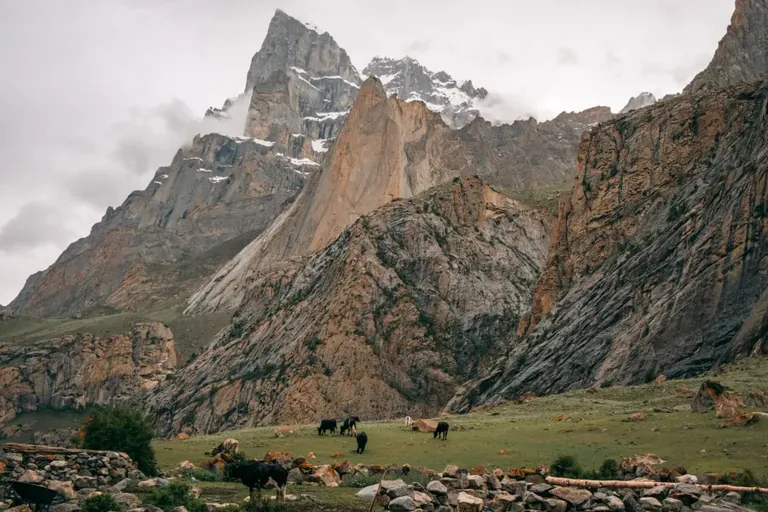
Nangma is a granite side valley of the Hushe Valley in Ghanche district, Baltistan, and it is the fastest way we know to stand under a genuinely world-class big wall. Three days of walking from the village of Kanday puts you on a meadow at 3,950 m, ringed by clean granite towers, with a day viewpoint at 4,300 m looking across at K6 (7,282 m). Climbers call it the Yosemite of Pakistan. Walkers get the same amphitheatre without touching a rope.
Where is Nangma Valley?
Nangma opens off the eastern side of the Hushe Valley, above Kanday village at about 2,680 m. Hushe is the same valley that feeds the southern approaches to Masherbrum and K6, so the scale is serious from the moment you leave the Shyok road. From Skardu it is roughly three hours on sealed road to Khaplu, then about two hours by jeep up the Hushe valley to the trailhead.
The granite: Amin Brakk and the towers
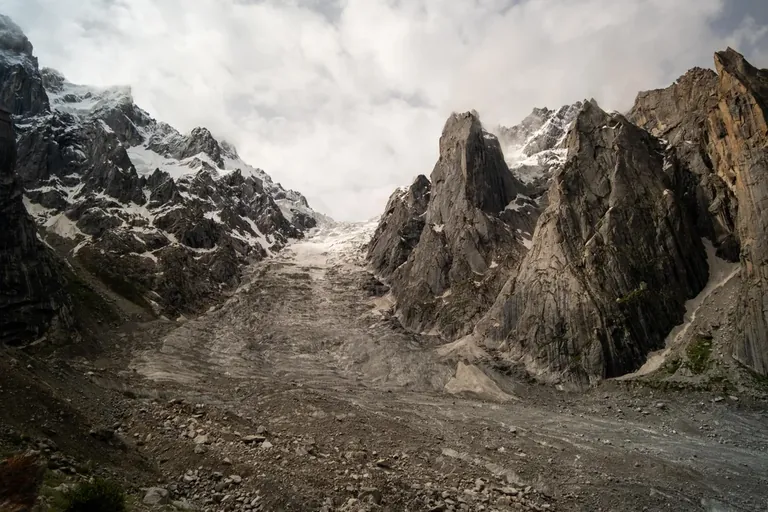
The valley is walled by the Great Tower, Grey Tower, Changi Tower and Amin Brakk, the one that made its name. Amin Brakk stands at roughly 5,850 m and its face runs about 1,200 m of near-vertical granite, among the larger walls anywhere. Silvia Vidal, Pep Masip and Miguel Puigdomenech made the first ascent in August 1999 after weeks on the wall. In July and August you will usually share the meadow with a climbing team or two, which is worth seeing even if you never leave the grass.
No permit, and why that matters
Nangma sits in an open zone. There is no No Objection Certificate to arrange, no Alpine Club of Pakistan trekking permit, and no peak royalty below 6,000 m. That is a real difference from the Baltoro side, where a trek to K2 Base Camp or Concordia needs an NOC, a permit and a per-person restricted-area fee. For Nangma we need your passport details and enough notice to arrange guides, porters and a jeep. Nothing else.
Who this trek suits
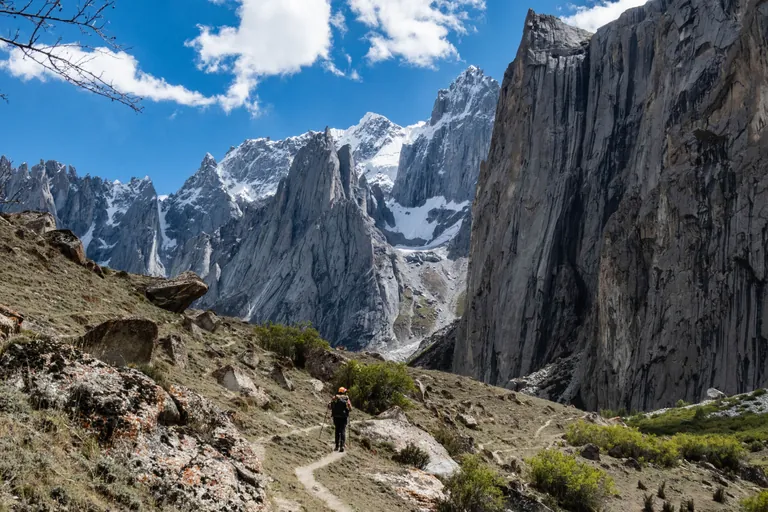
Fit walkers, including first-timers in the Karakoram. There is no technical ground, no glacier travel and no altitude high enough to be dangerous for a healthy trekker: you sleep at 3,950 m and the high point is a day walk to 4,300 m. What it asks for is steady uphill fitness on rough ground, comfort on two suspension bridges, and tolerance for cold nights. If you have done any two-day trek in Hunza, this is within reach.
When to go
Late June to mid-September. July and August are the most reliable: the meadows are green, the bridges are in, and the rock is dry. Late September can be beautiful and cold, with the risk that the herders have already brought their stock down. Before June there is snow on the upper meadow and the stream crossings run high with meltwater.
Combining Nangma with the Baltoro
Nangma works well as an acclimatisation leg or as a short second trip. The Gondogoro La crossing starts from this same Hushe side and finishes on the Baltoro under K2, so the two can run back to back from Skardu. For the full background on the valley, see our Nangma Valley trek guide.
Trek Itinerary: 3 Days
Day 1
Kanday to Mingulo Broq (3,500 m)
Kanday to Mingulo Broq (3,500 m)
Drive in from Khaplu and start walking at Kanday (about 2,680 m). Cross the Hushe River on a wooden bridge below the village, then climb into the narrowing valley over two suspension bridges. Four to six hours depending on load and pace. Camp on grass at Mingulo Broq with the towers directly above.
Day 2
Nangma meadows (3,950 m) and the K6 viewpoint (4,300 m)
Nangma meadows (3,950 m) and the K6 viewpoint (4,300 m)
A short morning up to the upper meadow beneath Amin Brakk and the towers, then a roughly three-hour round trip to the viewpoint for the K6 panorama. K6 is 7,282 m, the 22nd highest mountain in the world. Afternoon free on the meadow, where the climbing teams base.
Day 3
Return to Kanday and drive to Khaplu
Return to Kanday and drive to Khaplu
Downhill and quick, often a little over two hours back to the road at Kanday. Jeep to Khaplu, then on to Skardu the same day, or overnight in Khaplu for the fort.
What's Included
Not Included
Frequently Asked Questions About the Nangma Valley Trek
Do I need a permit for the Nangma Valley trek?
Do I need a permit for the Nangma Valley trek?
No. Nangma sits in an open zone, so there is no No Objection Certificate, no Alpine Club of Pakistan trekking permit, and no peak royalty below 6,000 m. We need your passport details for the checkposts, and that is all. That is a real difference from the Baltoro side, where a trek to K2 Base Camp or Concordia needs an NOC, a permit and a per-person restricted-area fee. For Nangma the only other thing we need is enough notice to arrange guides, porters and a jeep for your dates. The valley entry fee, checkpost paperwork and camp fees on the Nangma meadows are all included in our price. The highest point you reach on foot is the 4,300 m viewpoint facing K6, far below the 6,000 m line. Our guide is a local Balti from Hushe, so the arrangements in the valley are made by people who live there.
How difficult is the Nangma Valley trek?
How difficult is the Nangma Valley trek?
Moderate. There is no technical climbing and no glacier travel. You camp at 3,950 m and the highest point is a day walk to the 4,300 m viewpoint. You need steady uphill fitness on rough ground and to be comfortable on two suspension bridges. The first day, from Kanday at about 2,680 m to Mingulo Broq at 3,500 m, takes four to six hours depending on load and pace. Day two is a short morning to the upper meadow, then a round trip of about three hours to the viewpoint for K6. The walk out on day three is downhill and often only a little over two hours. Nights are cold, so bring warm layers. Porters carry the camp and food. If you have done any two-day trek in Hunza, this is within reach, and it suits fit walkers who are new to the Karakoram.
How long is the trek and where does it start?
How long is the trek and where does it start?
Three days of walking from Kanday village in the Hushe Valley, with camps at Mingulo Broq (3,500 m) and the Nangma meadows (3,950 m). Kanday is about three hours from Skardu to Khaplu on sealed road, then two hours by jeep. The village sits at about 2,680 m where Nangma opens off the eastern side of the Hushe Valley. Day one crosses the Hushe River on a wooden bridge below the village, then two suspension bridges, to reach Mingulo Broq in four to six hours. Day two climbs to the upper meadow beneath Amin Brakk and the towers, with a round trip of about three hours to the 4,300 m viewpoint facing K6. Day three drops back to Kanday, usually in a little over two hours, then a jeep to Khaplu. You can continue to Skardu the same day or stay overnight in Khaplu for the fort. The jeep between Khaplu and Kanday is included.
What is the best time of year to trek Nangma?
What is the best time of year to trek Nangma?
Late June to mid-September, with July and August the most reliable. In those two months the meadows are green, the bridges are in and the rock is dry, and you will usually share the meadow with a climbing team or two working on the walls. Late September can be beautiful and cold, with the risk that the herders have already brought their stock down. Before June there is snow on the upper meadow and the stream crossings run high with meltwater. Winter is not a trekking season here. Nights at the 3,950 m camp are cold even in summer, so bring proper warm layers whenever you go. If you are planning Nangma as an acclimatisation leg before the Baltoro, tell us your dates early and we will fit both into the same summer window from Skardu.
How high is Amin Brakk?
How high is Amin Brakk?
Amin Brakk is roughly 5,850 m, with a granite face of about 1,200 m. It was first climbed in August 1999 by Silvia Vidal, Pep Masip and Miguel Puigdomenech, after weeks on the wall. It is the tower that made Nangma's name, and it stands with the Great Tower, Grey Tower and Changi Tower around the upper meadow. The near-vertical face is among the larger big walls anywhere, which is why climbers call Nangma the Yosemite of Pakistan. As a trekker you get the same view without touching a rope: the camp on the Nangma meadows at 3,950 m sits beneath Amin Brakk and the towers. In July and August there is often a climbing team or two based on the meadow, and watching them on the wall is worth the trip even if you never leave the grass. Across the valley from the viewpoint you also see K6 at 7,282 m.
Can I combine Nangma with the K2 Base Camp trek?
Can I combine Nangma with the K2 Base Camp trek?
Yes. Nangma works well as an acclimatisation leg before the Baltoro, and the Gondogoro La crossing starts from the same Hushe side. Tell us your dates and we will sequence both from Skardu. The Gondogoro La route finishes on the Baltoro under K2, so the two can run back to back. Three days in Nangma, with a night at 3,950 m and a day walk to the 4,300 m viewpoint facing K6, gives your body a useful start on altitude before the bigger trek. Keep in mind that the paperwork differs. Nangma is open zone with no permit, while K2 Base Camp and Concordia need an NOC, a trekking permit and a per-person restricted-area fee. Nangma also works the other way round, as a short second trip after the Baltoro. From the meadows you come out to Khaplu and can be back in Skardu the same day.
Ready for Your Next Adventure?
Join our community of explorers and discover the journey of a lifetime. Our expert team is ready to help you plan your perfect expedition.