Spantik: Golden Peak
A classic Karakoram objective
Last updated: · Reviewed by Javeed Iqbal, Founder
Elevation
7,027m
Difficulty
Extreme
Duration
30 to 40 Days
Best Season
Jun to Aug
Spantik expedition: a complete guide to climbing Golden Peak (7,027m)
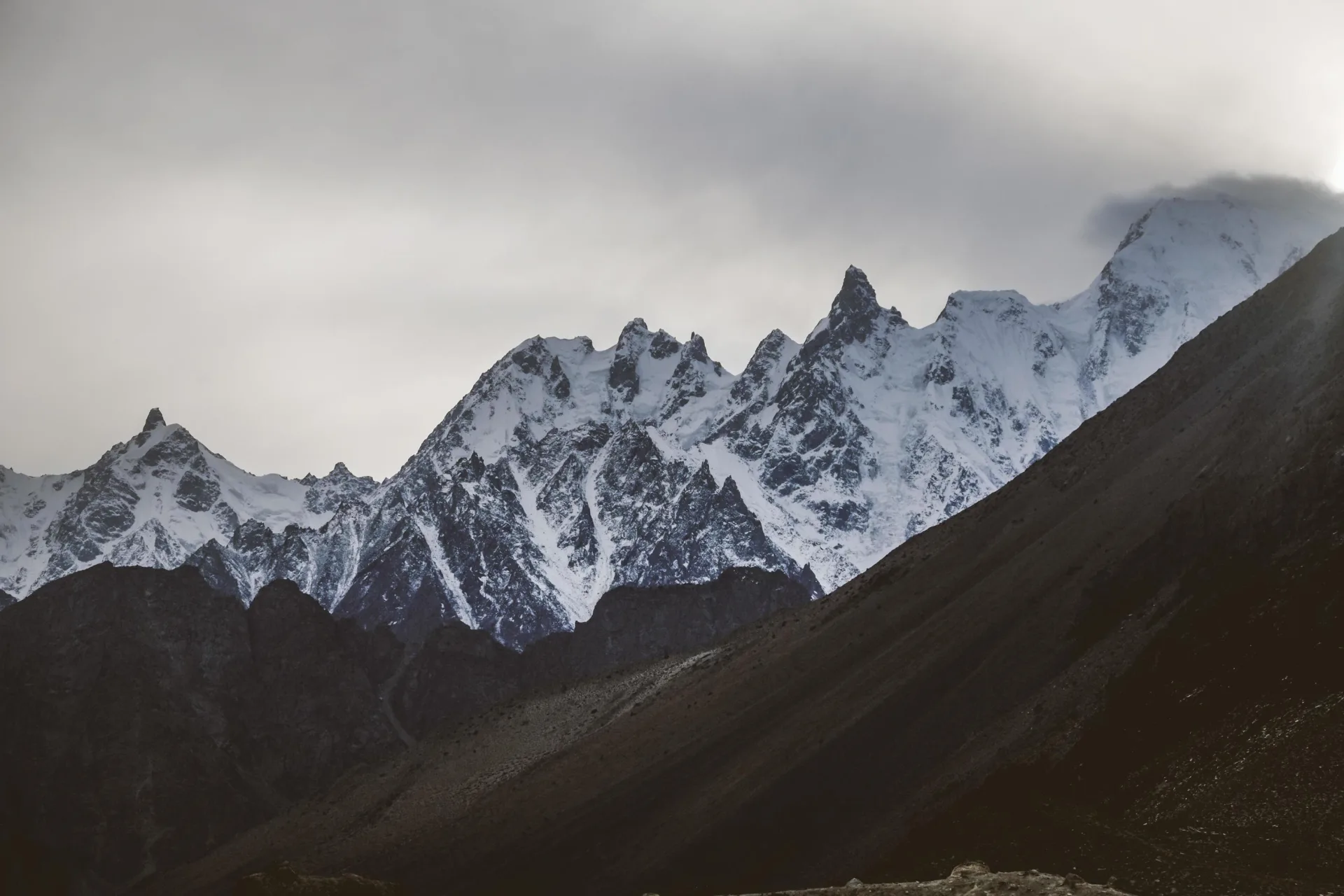
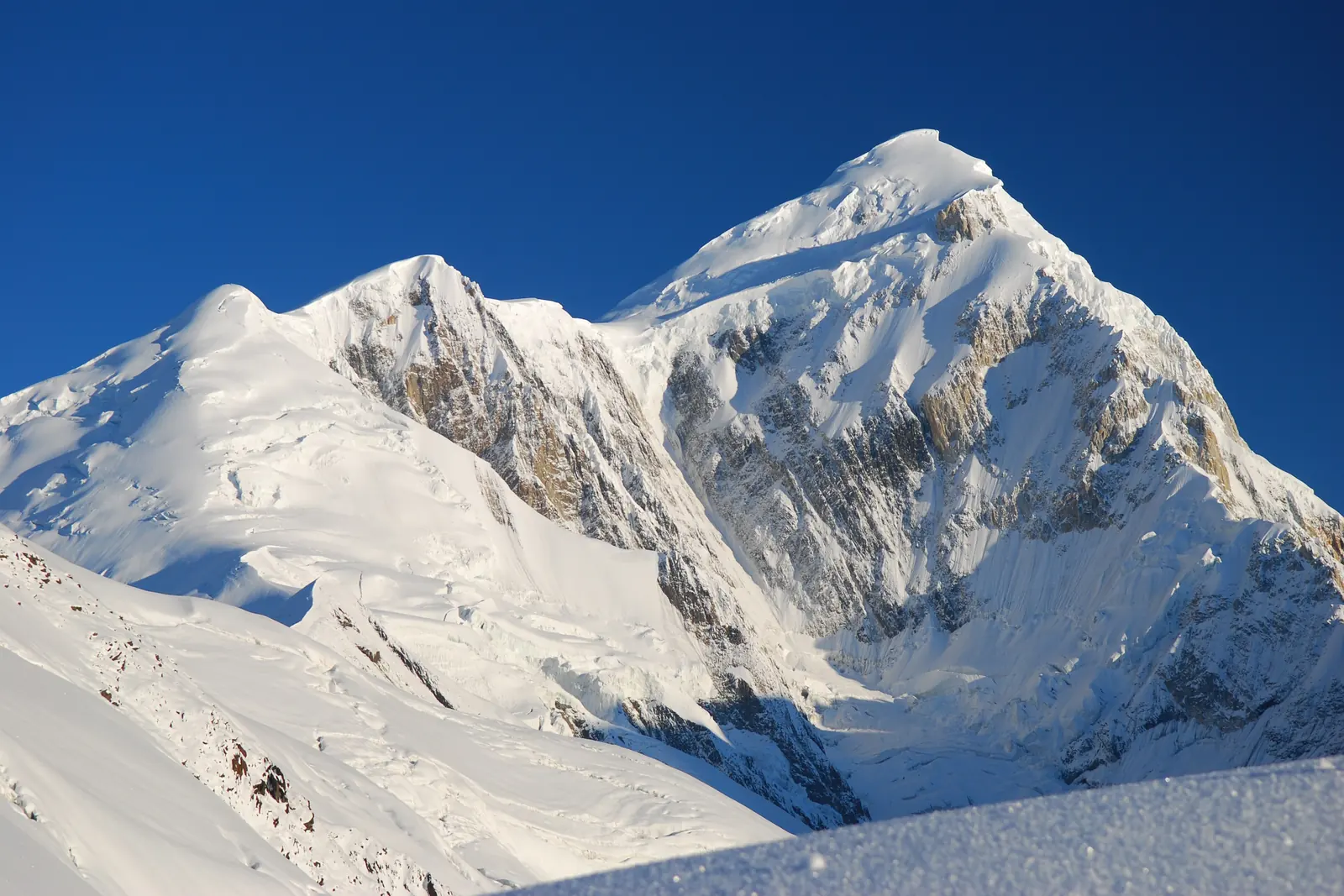
Spantik, known as Golden Peak, stands at 7,027 metres (23,054 feet) in the Spantik-Sosbun range of the Karakoram, in Shigar District, Gilgit-Baltistan. It is the most popular guided seven-thousander in Pakistan for one straightforward reason: the Southeast Ridge, the standard route, is a serious and genuine high-altitude expedition, but it does not demand the extreme technical skill of the 8,000-metre giants. That combination has made it the go-to acclimatisation and preparation peak for climbers building toward K2, Nanga Parbat or the other big objectives in the range. A Spantik expedition is 30 to 40 days and hard work at altitude.
Where is Spantik?
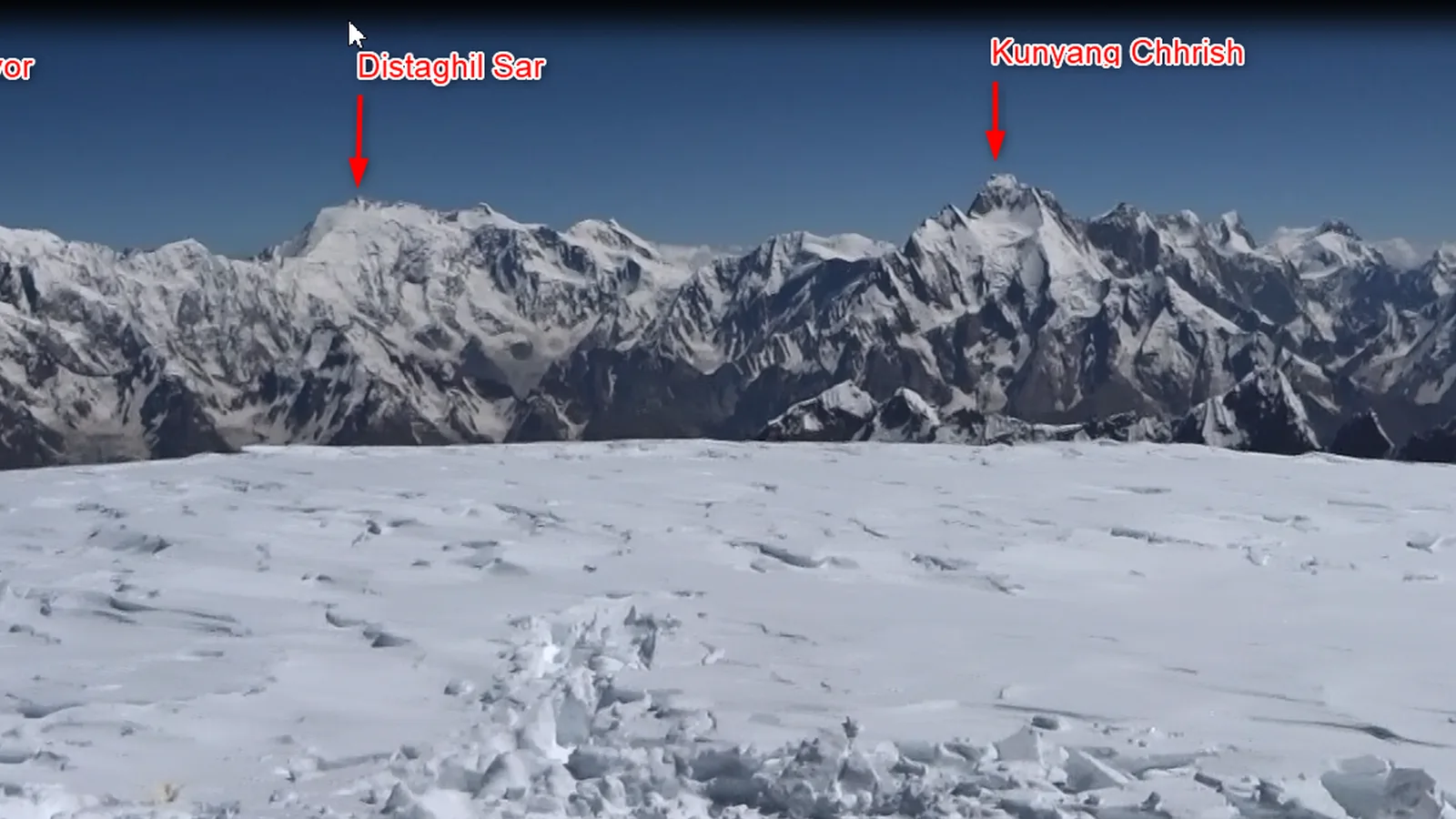
Spantik sits in the Spantik-Sosbun sub-range of the central Karakoram, administratively in Shigar District of Gilgit-Baltistan, Pakistan. The approach comes from Skardu, the main hub for Karakoram expeditions, with a long jeep drive up the Shigar Valley to the village of Arandu. Above Arandu the Chogolungma Glacier carries you into one of the remotest corners of the range. The mountain lies to the south of the great Hispar Glacier, and from high on the Southeast Ridge you can see peaks in every direction including K2 and Nanga Parbat on a clear day. Spantik has a Burushaski name, Ganesh Chish, which also translates as Golden Peak.
How hard is Spantik, and is it a good training peak for 8,000m?
Spantik is a genuine high-altitude expedition, not a trekking peak dressed up. The Southeast Ridge rises 2,700 metres over 7.6 kilometres, most of it at angles under 30 degrees with a few steeper sections approaching 40 degrees on snow and ice. It is long, cold, and physically taxing, and the summit day runs 8 to 10 hours. But it does not have the extreme objective hazards of the Karakoram's 8,000-metre peaks. There is no feature like the Bottleneck on K2, no icefall as chaotic as the Khumbu. The route can be fixed and managed with a well-run guided team, and supplemental oxygen is not usually required.
For these reasons Spantik has become the standard stepping stone for climbers who want their first serious Karakoram expedition before attempting an 8,000er. The altitude, the duration, the glacier travel and the ridge climbing are all genuine preparation. Many climbers who eventually reach the summit of K2 or Broad Peak have Spantik in their record.
The Southeast Ridge: Spantik's normal route
The Southeast Ridge is climbed in four camps. From Base Camp at about 4,200 metres on the Chogolungma Glacier, the route moves up to Camp 1 at around 5,100 metres, which sits on a relatively sheltered snow platform. Camp 2 follows at roughly 5,500 metres as the ridge begins to sharpen. Camp 3, the high camp, is placed at about 6,250 metres; from there the summit push of roughly 600 vertical metres takes 8 to 10 hours on the day. The ridge narrows in its upper section and becomes exposed on both flanks, and teams move in good weather windows to keep that stretch safe. Fixed ropes are placed on the harder sections, and the descent follows the ascent route.
The approach: Skardu, Arandu and the Chogolungma Glacier
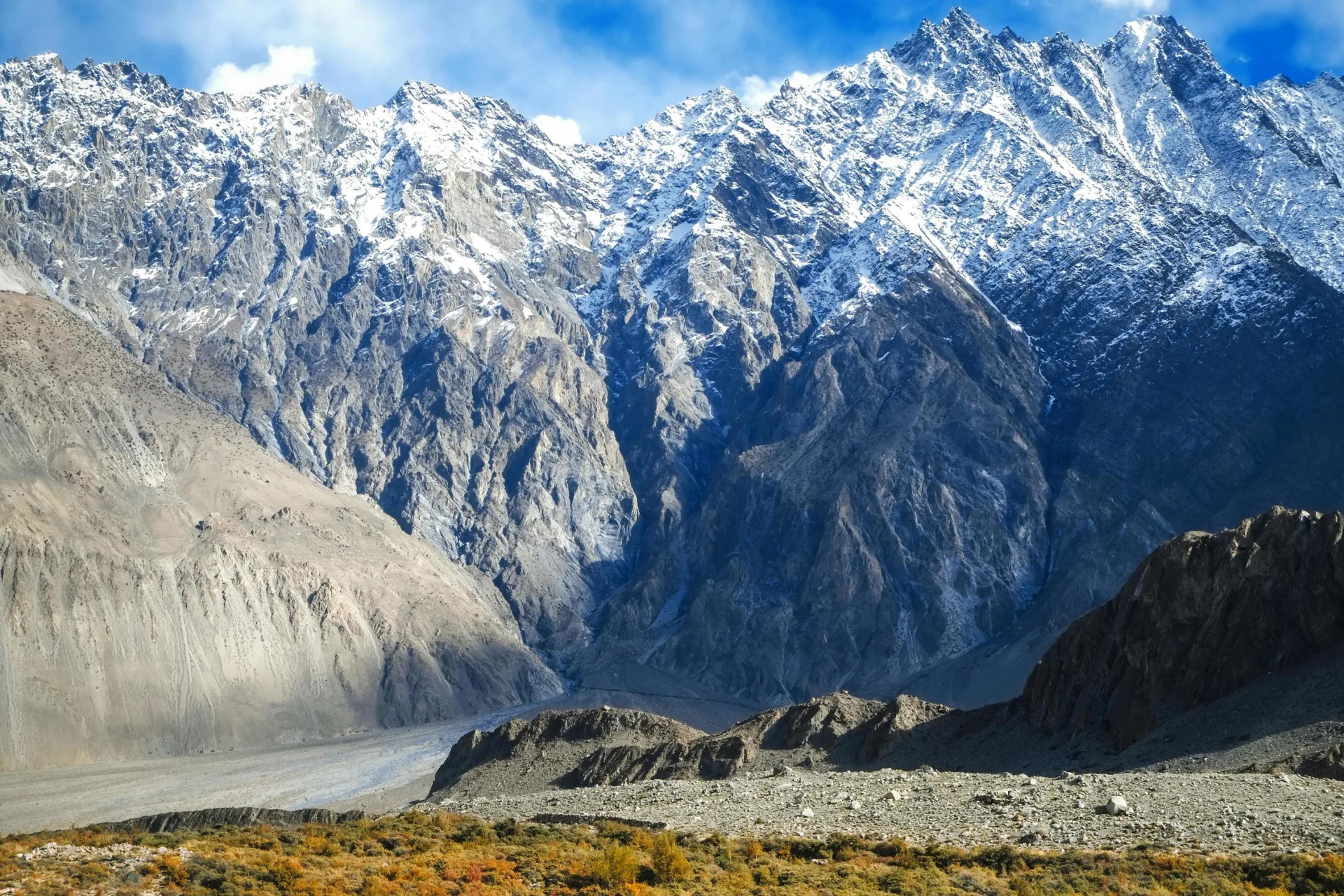
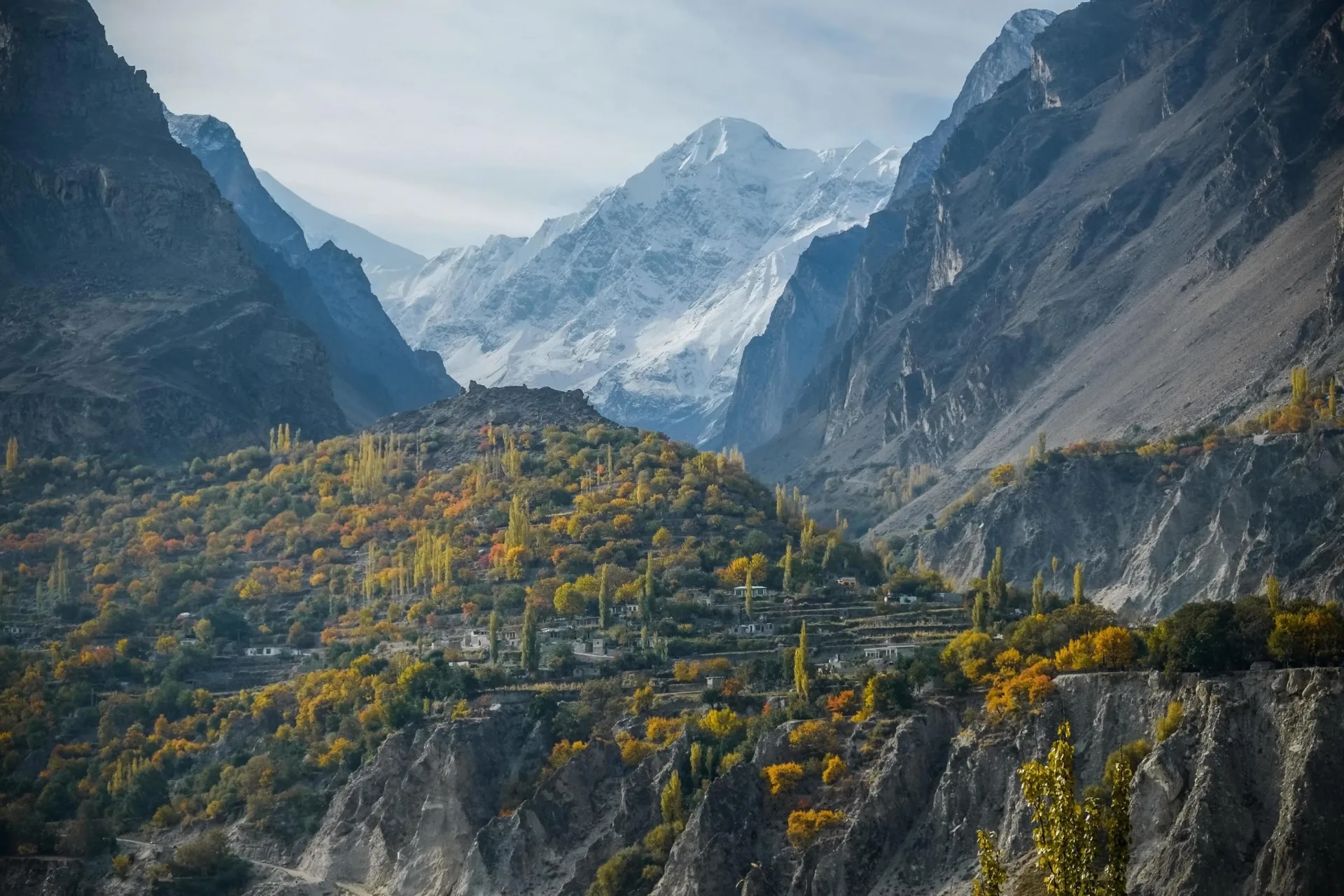
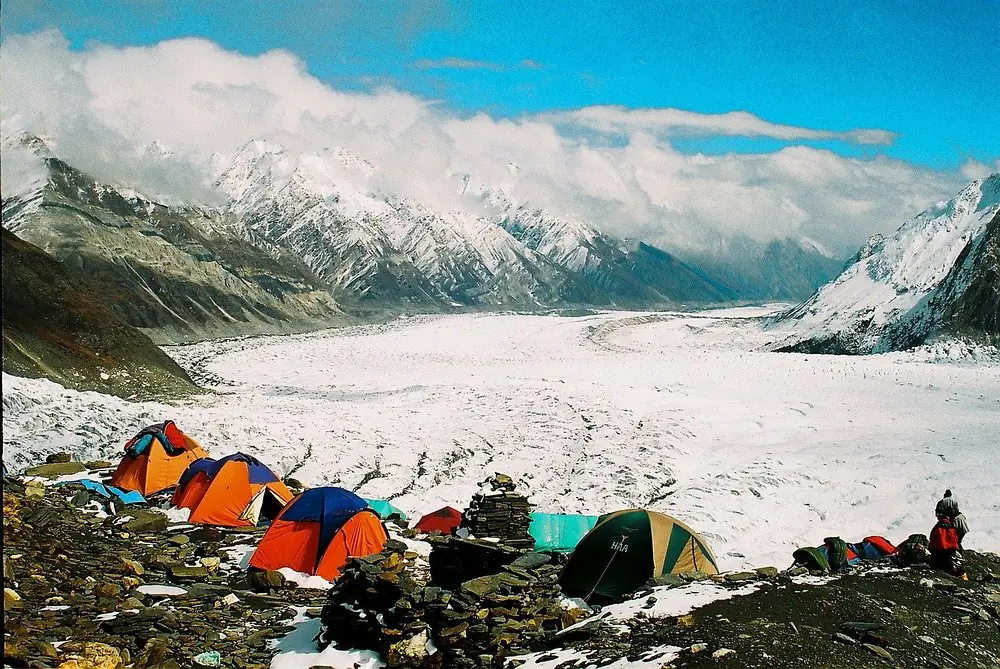
The expedition starts in Skardu, the logistical base for the whole central Karakoram. From Skardu a jeep drive of roughly six to seven hours up the Shigar Valley reaches Arandu, the last village before the mountains close in. The trek from Arandu follows the Chogolungma Glacier for three to four days through high-altitude desert terrain to Base Camp. The approach is remote. There are no teahouses, no fixed camps, and no road beyond Arandu. The isolation is part of what makes the expedition valuable as preparation for larger objectives, and the glacial scenery on the walk in is some of the best in the Karakoram.
The Golden Pillar: Spantik's famous northwest face
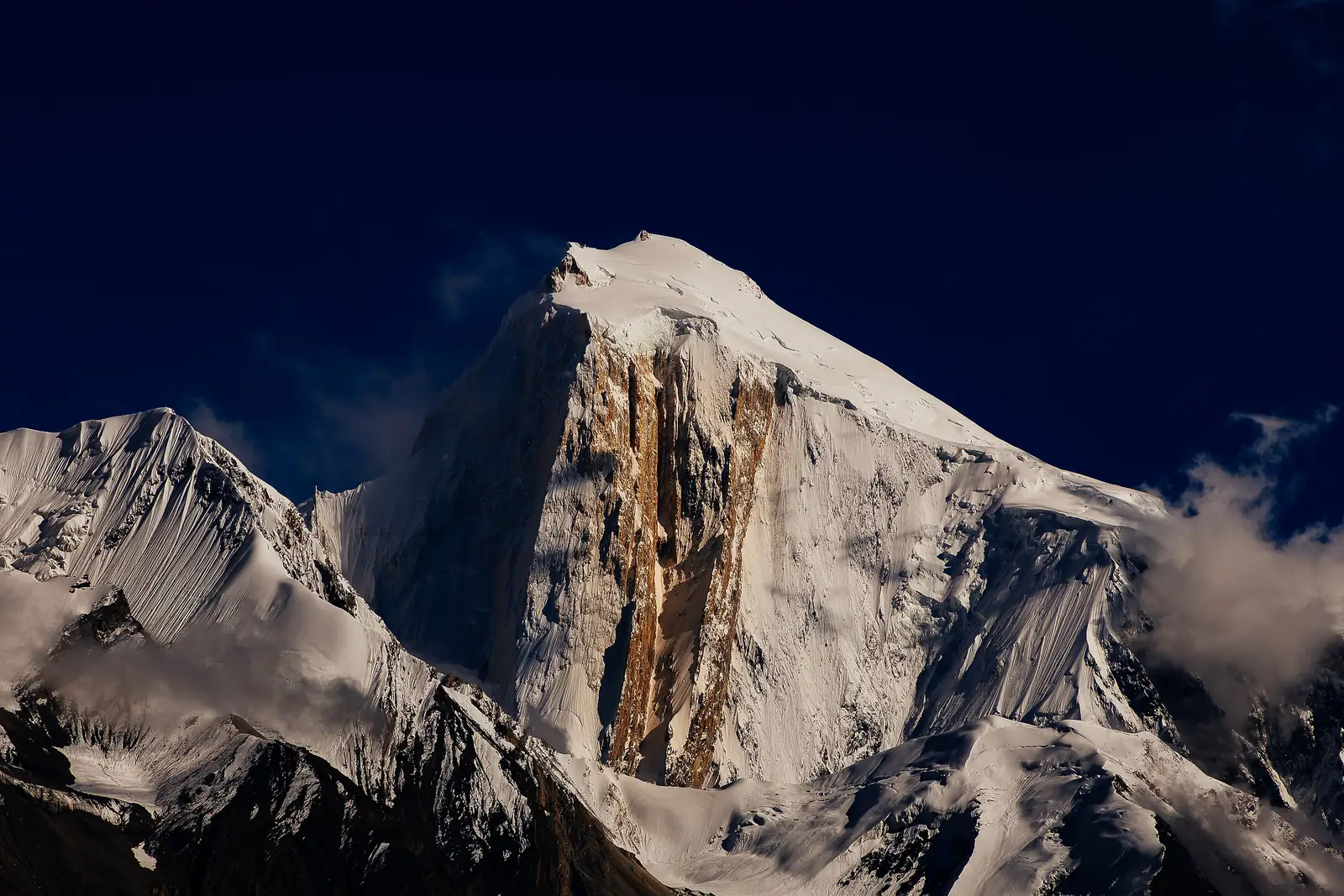
When climbers and alpinists talk about the Golden Pillar, they are talking about a specific feature on Spantik's northwest face: a pronounced column of creamy yellow marble that rises almost 300 metres below the summit, turning a deep gold in the morning light. The standard expedition route does not touch it. The Pillar is the line of one of the best-known alpine ascents in the Karakoram: in 1987, British alpinists Mick Fowler and Victor Saunders climbed the northwest face by a direct line up the Pillar, a technically extreme undertaking that took the mountaineering world's attention and won both climbers lasting reputations. Saunders wrote about the ascent in *Elusive Summits* (1990) and Fowler in *Vertical Pleasure* (1995). The route remains a serious objective for elite alpinists. For the guided expedition, the southeast approach is the correct line.
Best time to climb Spantik
The season is June to August. The Karakoram summer brings the most stable weather windows and the longest days, both of which matter on a mountain where the standard summit push is an all-day affair. July is usually the prime month. Earlier in the season the mountain carries more snow and the risk of avalanche on the lower slopes is higher. Later in August, the windows shorten and the approach can become icy and unstable. A full expedition of 30 to 40 days allows for the approach, multiple acclimatisation rotations, rest periods and the patience to wait for a reliable weather window before the summit bid.
Acclimatisation, rotations and oxygen
After the approach trek, the team settles into a programme of rotations up the Southeast Ridge. The first rotation typically reaches Camp 1 or Camp 2, then returns to Base Camp for rest. A second rotation goes higher before the final push. This stepped pattern gives the body time to produce more red blood cells and function at altitude, and it also lets the team assess conditions on the upper mountain before committing. Most Spantik climbers do not use supplemental oxygen; the summit is below the altitude where it becomes critical for most fit climbers. A well-planned schedule still carries emergency oxygen, and a strong high-altitude team is standard on any reputable guided expedition.
The dangers: glacier, weather and altitude
Spantik is safer than the 8,000-metre peaks in many respects, but it is still a serious mountain at serious altitude. The Chogolungma Glacier approach has crevasse hazard and requires careful rope management. The Southeast Ridge carries avalanche risk on the lower slopes after heavy snowfall, and teams need to time their movements accordingly. At 7,000 metres the altitude is high enough to impair judgement and physical performance significantly, and the summit day is long enough that poor pacing or a sudden weather change can put climbers in a difficult position. The descent, as on every high mountain, is where most accidents happen. Conservative turnaround times and disciplined weather assessment are what keep teams safe.
Permits, royalty and cost
A Spantik expedition requires a Pakistan mountaineering permit and a peak royalty paid to Gilgit-Baltistan, along with a liaison officer assigned to the team. Because Spantik sits below 8,000 metres, its permit fees are considerably lower than the 8,000-metre peaks, making it one of the better-value serious expeditions in the Karakoram. A fully supported expedition covering permit and liaison handling, Skardu-to-Arandu logistics and jeep transfers, the Chogolungma approach, fixed camps, high-altitude support staff, and base-camp services typically starts from around $17,000 per climber. Pricing here is indicative; we quote each expedition individually by team size and support level.
What it takes to climb Spantik
Spantik is an excellent first major Karakoram expedition for climbers who already have real mountain experience. Operators expect solid prior time on snow and ice at altitude, confidence with crampons and fixed ropes on steep terrain, and the physical condition to sustain effort across a 30-to-40-day expedition. Previous climbs in the 5,000 to 6,000-metre range are the usual minimum. Beyond technical readiness, the mountain rewards patience and judgement: the ability to rest when rest is needed, to wait for the right weather window, and to turn around if conditions are not right. Those qualities matter as much as raw fitness.
Go With Guide Pakistan runs fully supported Spantik expeditions with experienced Pakistani high-altitude guides, complete Skardu and Shigar Valley logistics, permit and liaison handling, fixed camps on the Southeast Ridge, and full base-camp support. Spantik is also an excellent way to see this remote corner of the Karakoram, and we can combine the expedition with wider Gilgit-Baltistan itineraries on request.
Climbing History
1906
First High Attempt
First High Attempt
American mountaineers Fanny Bullock-Workman and William Hunter Bullock-Workman attempted the Southeast Ridge and reached approximately 6,700 metres, a remarkable high-point for the era and the first serious mountaineering push on Spantik.
1955
First Ascent
First Ascent
Germans Reiner Diepen, Eduard Reinhardt and Jochen Tietze reached the summit via the Southeast Ridge and the Chogolungma Glacier, establishing the route that remains the standard line today.
1987
The Golden Pillar
The Golden Pillar
Mick Fowler and Victor Saunders (UK) made the first ascent of the Golden Pillar on the northwest face, among the most celebrated alpine-style ascents in Karakoram history. The route is described in Saunders's book Elusive Summits and Fowler's Vertical Pleasure.
Present
A Premier Training Peak
A Premier Training Peak
Spantik is now the most popular guided seven-thousander in the Karakoram, sought by climbers from around the world as preparation for K2 and the other 8,000-metre peaks of Pakistan.
Recommended Reading
Elusive Summits: Four Expeditions in the Karakoram
by Victor Saunders (1990)
Elusive Summits: Four Expeditions in the Karakoram
by Victor Saunders (1990)
Vertical Pleasure
by Mick Fowler (1995)
Vertical Pleasure
by Mick Fowler (1995)
Frequently Asked Questions About the Spantik Expedition
Where is Spantik and how tall is it?
Where is Spantik and how tall is it?
Spantik, also called Golden Peak, is 7,027 metres (23,054 feet) high and stands in the Spantik-Sosbun sub-range of the central Karakoram, in Shigar District, Gilgit-Baltistan, Pakistan. It lies south of the Hispar Glacier, and its Burushaski name, Ganesh Chish, also translates as Golden Peak. The approach starts in Skardu, the main hub for Karakoram expeditions. A jeep drive of roughly six to seven hours up the Shigar Valley reaches Arandu, the last village, and from there the trek follows the Chogolungma Glacier for three to four days to Base Camp at about 4,200 metres. There are no teahouses, no fixed camps and no road beyond Arandu, which makes this one of the remotest corners of the range. From high on the Southeast Ridge, the standard route, you can see K2 and Nanga Parbat on a clear day. The jeep transfers from Skardu via the Shigar Valley are included in our expedition.
What is the difference between Spantik, Golden Peak and the Golden Pillar?
What is the difference between Spantik, Golden Peak and the Golden Pillar?
Spantik and Golden Peak are two names for the same 7,027-metre mountain; the Golden Pillar is one feature on it and the route that climbs that feature. The Pillar is a pronounced column of creamy yellow marble on the northwest face, rising almost 300 metres below the summit and turning deep gold in the morning light. In 1987 British alpinists Mick Fowler and Victor Saunders made its first ascent by a direct line, a technically extreme climb that is still among the most celebrated alpine-style ascents in Karakoram history. Saunders wrote about it in Elusive Summits (1990) and Fowler in Vertical Pleasure (1995). The Pillar remains an objective for elite alpinists only. Guided expeditions, including ours, climb the Southeast Ridge instead, the line of the 1955 first ascent by Diepen, Reinhardt and Tietze. It is serious high-altitude work, but it never touches the Pillar.
Is Spantik a good training peak for K2 or other 8,000m peaks?
Is Spantik a good training peak for K2 or other 8,000m peaks?
Yes. Spantik is the most popular stepping-stone expedition for climbers heading to K2 and the other 8,000-metre peaks of the Karakoram. The Southeast Ridge rises 2,700 metres over 7.6 kilometres, mostly under 30 degrees with a few sections approaching 40 degrees on snow and ice, and the summit day runs 8 to 10 hours. That gives you real high-altitude experience, glacier travel, ridge climbing and camp rotations over a 30 to 40 day expedition. What it lacks are the extreme objective hazards of the 8,000ers: there is nothing like the Bottleneck on K2 or the Khumbu icefall. Many climbers who later summit K2 or Broad Peak have Spantik in their record. It is not a first mountain, though. Operators expect prior climbs in the 5,000 to 6,000-metre range, confidence with crampons and fixed ropes on steep terrain, and the fitness to sustain effort for weeks.
How long does a Spantik expedition take and when is the best time?
How long does a Spantik expedition take and when is the best time?
A full Spantik expedition takes 30 to 40 days, and the best season is June to August, with July usually the prime month. The time goes on a six to seven hour jeep drive from Skardu up the Shigar Valley to Arandu, three to four days trekking up the Chogolungma Glacier to Base Camp at about 4,200 metres, then acclimatisation rotations on the Southeast Ridge. The first rotation usually reaches Camp 1 or Camp 2 before returning to Base Camp, and a second goes higher before the summit push from Camp 3 at about 6,250 metres. Much of the remaining time is patience, waiting for a reliable weather window. Earlier in the season the mountain carries more snow and higher avalanche risk on the lower slopes. Later in August the windows shorten and the approach can turn icy and unstable. July brings the most stable weather and long days, which matter on an all-day summit push.
Do you need supplemental oxygen on Spantik?
Do you need supplemental oxygen on Spantik?
Most climbers do not use supplemental oxygen on Spantik. At 7,027 metres the summit is below the altitude where oxygen becomes critical for most fit climbers who have acclimatised well. That acclimatisation is what the expedition is built around: after the approach, the team makes a first rotation to Camp 1 at around 5,100 metres or Camp 2 at roughly 5,500 metres, returns to Base Camp to rest, then makes a second, higher rotation before the final push. Summit day from Camp 3 at about 6,250 metres is roughly 600 vertical metres and 8 to 10 hours. Going without oxygen does not make the altitude easy. At 7,000 metres judgement and physical performance are significantly impaired, which is why we keep conservative turnaround times. Emergency oxygen and a comprehensive medical kit are included in our expedition, along with experienced Pakistani high-altitude porters and climbing guides.
How much does a Spantik expedition cost?
How much does a Spantik expedition cost?
A fully supported Spantik expedition typically starts from around $17,000 per climber, and we quote each expedition individually by team size and support level. That price covers the Pakistan mountaineering permit and the peak royalty paid to Gilgit-Baltistan, the liaison officer and base camp staff, jeep transfers from Skardu up the Shigar Valley, the Chogolungma approach, all camps, tents and high-altitude equipment, emergency oxygen and a comprehensive medical kit, and experienced Pakistani high-altitude porters and climbing guides. You pay separately for international flights, travel insurance, personal expenses and your personal climbing gear. Because Spantik sits below 8,000 metres, its permit fees are considerably lower than those of the 8,000-metre peaks, which makes it one of the better-value serious expeditions in the Karakoram. Custom expeditions are available for groups of 2 or more. Contact us with your dates and team size for an exact quote.
What's Included
Not Included
Ready for Your Next Adventure?
Join our community of explorers and discover the journey of a lifetime. Our expert team is ready to help you plan your perfect expedition.