Fairy Meadows, Pakistan: The Complete Guide (2026/2027)
A licensed local operator's complete guide to Fairy Meadows: where it is, how to reach it, the truth about the jeep road, the best time to go, what it costs, and the trek to Nanga Parbat base camp.
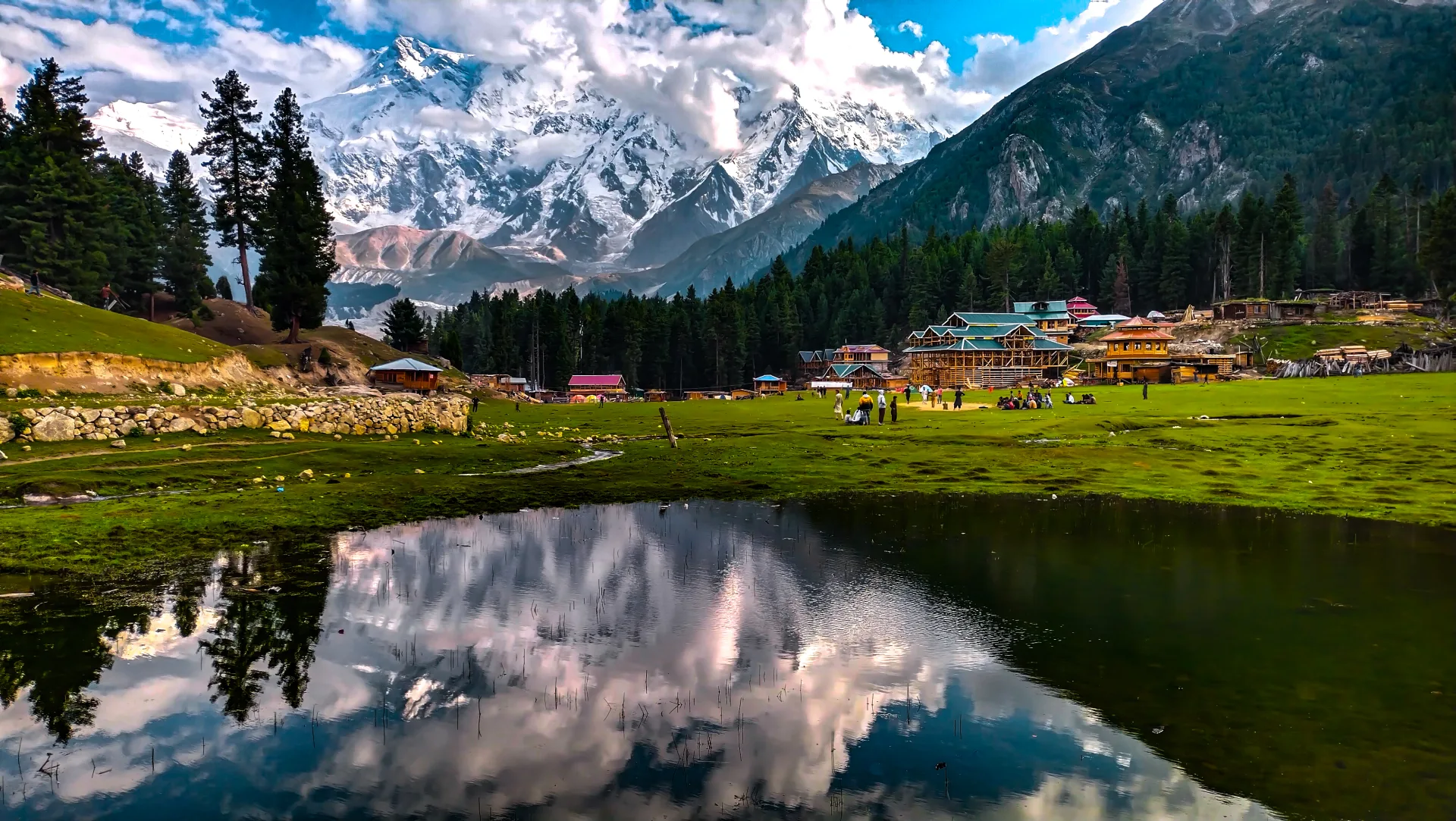
Fairy Meadows is the trip almost every first visit to northern Pakistan is built around, and for good reason. You climb out of a jeep at the edge of a pine forest, walk uphill through the trees, and step out onto a green alpine shelf with the ice wall of Nanga Parbat, the ninth-highest mountain on earth, filling the whole southern sky. This guide is the practical version: where Fairy Meadows actually is, how you get there, the truth about the jeep road, when to go, what it costs, where to sleep, and how to carry on to Nanga Parbat base camp. It is written by a licensed operator who runs this route every season.
Where is Fairy Meadows, and how high is it?
Fairy Meadows is a grassy plateau of pine and birch at about 3,300 metres (10,800 ft) in the Diamer District of Gilgit-Baltistan, on the northern, or Raikot, face of Nanga Parbat (8,126 m). The mountain is the western anchor of the Himalaya and one of the fourteen eight-thousanders. Austrian climber Hermann Buhl made the first ascent in 1953, and its fearsome early record earned it the nickname the "Killer Mountain," though from the meadow you simply see a giant, glittering pyramid rather than anything sinister.
The name is a German invention. Climbers on the 1930s Nanga Parbat expeditions called the spot Märchenwiese, or "fairy-tale meadow," and the English version stuck; the local Shina name is Joot. The whole area now sits inside Nanga Parbat National Park, so treat it as protected ground and carry your rubbish out.
Quick facts: Elevation ~3,300 m · Mountain: Nanga Parbat, 8,126 m · Region: Diamer, Gilgit-Baltistan · Access: Raikot Bridge on the Karakoram Highway, then 4x4 jeep and a 3 to 4 hour trek · Season: roughly May to October · Nearest towns: Chilas and Gilgit.
How to reach Fairy Meadows, step by step
Getting there is half the adventure and the part that trips people up, so here is the honest sequence. Everyone converges on Raikot Bridge on the Karakoram Highway, where the tarmac ends and the jeeps wait. From the bridge you cannot drive your own vehicle: only the local union jeeps run the track up to Tato village, and from Tato you walk.
| Leg | How | Time |
|---|---|---|
| Islamabad to Chilas / Raikot Bridge | Private vehicle on the Karakoram Highway (about 410 to 490 km) | 10 to 15 hours, usually split with a night near Chilas |
| Raikot Bridge to Tato village | Union 4x4 jeep (fixed collective, no private cars) | ~15 to 16 km, about 1.5 hours |
| Tato to Fairy Meadows | Trek on foot (or a hired pony) | ~5 km, 3 to 4 hours, climbing 700 to 800 m |
There are three ways to reach Raikot Bridge from Islamabad:
- The Karakoram Highway via Kohistan (open all year): Islamabad to Abbottabad, Besham, Dasu and Chilas, then Raikot Bridge. Roughly 490 km and 12 to 15 hours. This is the only route that works outside summer.
- The Naran and Babusar Pass route (June to September only): Islamabad to Naran, over the Babusar Pass at 4,173 m, down to Chilas and on to Raikot. Shorter at about 410 km and far more scenic, but it depends on the pass being open and clear.
- By air: fly Islamabad to Gilgit (about an hour, weather permitting), then drive the 77 km south to Raikot Bridge. This cuts almost two days off the trip, but the flight is famously prone to cancellation, so keep a road day in reserve.
A few rules that save trouble: leave Islamabad before dawn, never drive the Karakoram Highway after dark, and top up fuel and cash in Chilas or Gilgit because they hold the last reliable ATMs and petrol before the mountains. If you would rather skip the logistics entirely, our guided Fairy Meadows tour handles the transport, the jeep and the permits as one package.
The Raikot jeep road: how dangerous is it really?
You will have seen the headlines calling this one of the most dangerous roads in the world. The track is a narrow, unpaved shelf cut into the mountainside with no barriers and a long drop on the open side, and in places it is barely wider than the jeep. The reputation is not invented.
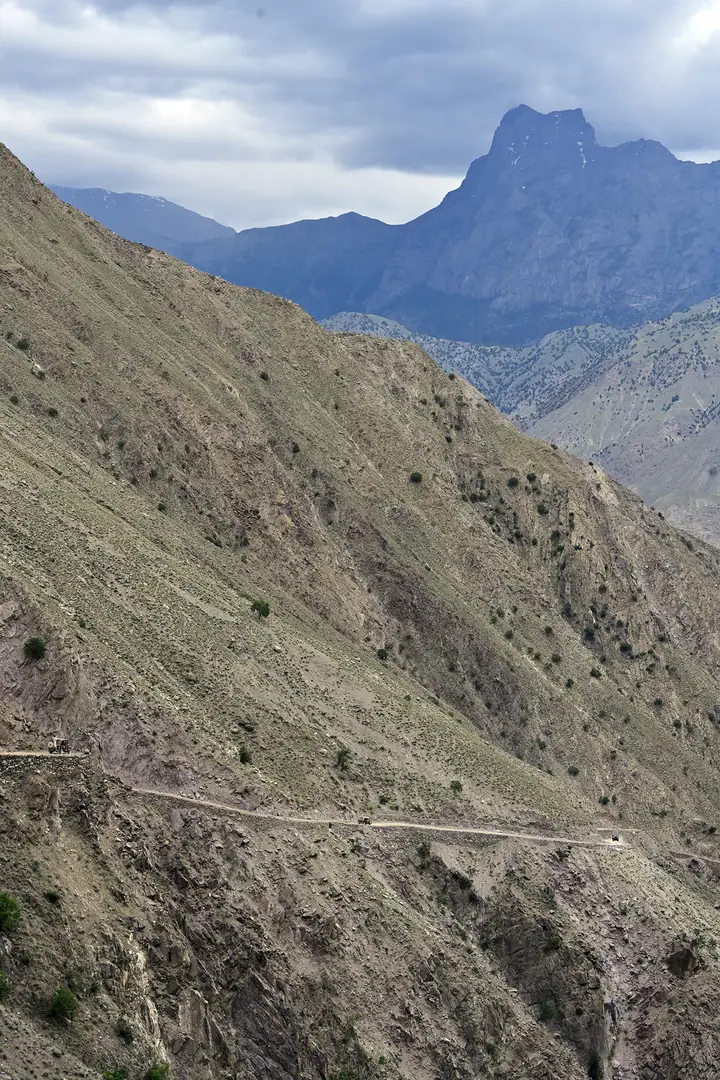
The reality is calmer than the clickbait. The road is run by a union of local drivers who have driven it for decades, they go slowly, they know every passing spot, and their safety record with tourists is good. The real risks are vertigo and motion sickness rather than a crash, so if you are prone to either, sit on the inside, look up the slope rather than down, and say so before you start. The one thing not to do is drive it yourself in a rented car, which is both against the union rules and genuinely unwise. Sit back, let the driver work, and treat the ride as part of the story.
The trek up to Fairy Meadows
From Tato the only way in is on your own feet. It is about 5 km and 3 to 4 hours, climbing 700 to 800 metres through pine forest that opens now and then to a first, teasing view of Nanga Parbat. It is a steady uphill rather than a technical climb, and a reasonably fit walker of any age manages it, but the altitude makes it feel harder than the distance suggests, so go slowly and drink often. Ponies and porters wait at Tato if you would rather not carry a pack, at a fixed local rate.
Best time to visit Fairy Meadows
Fairy Meadows is a summer place. The jeep track and the cottages open around May or June once the snow clears and shut again by late September or October. In the deep of winter the meadow is buried and there is no access at all. Within the season each month has its own character.
| Month | Conditions | Good for |
|---|---|---|
| May | Fresh green, few crowds, clear skies, 10 to 18°C by day | Quiet, blossom, stargazing |
| June to July | Peak season, the most reliable clear views of Nanga Parbat, 15 to 22°C | Photography, first-timers, the reflection lake |
| August | Warm but monsoon moisture, cloudier mornings, some landslide risk on the approach | Lush scenery if your dates stay flexible |
| September | Stable, quiet, exceptionally clear air, 8 to 16°C | The connoisseur's month: thin crowds, sharp mountain |
| October | Autumn colour but cold nights and facilities closing, 2 to 10°C | Late, crisp visits before the season ends |
| Nov to April | Closed, snowbound, no jeep access | Not accessible |
If you want one recommendation: June and July give the surest mountain views, while May and September are the sweet spot for anyone who prefers space and silence over the busiest weeks. Whenever you come, the nights are cold at this altitude, so pack a warm jacket even in midsummer.
What a Fairy Meadows trip costs
Costs split into two worlds: doing it yourself piece by piece, or booking a guided package. Prices below are 2026 season figures and move with fuel and demand, so treat them as a guide rather than a quote.
| Item | Typical cost |
|---|---|
| Union jeep, Raikot Bridge round trip (per vehicle, 5 to 6 people) | PKR 16,000 to 20,000 |
| Pony from Tato to Fairy Meadows (one way) | PKR 2,500 to 4,000 |
| Cottage, per night | PKR 2,000 to 5,000 |
| Food, per person per day | PKR 1,500 to 2,500 |
| Guided domestic package (5 days, from Islamabad) | PKR 25,000 to 85,000 |
| Guided trek for foreign visitors (9 days, base camp) | USD 750 to 1,190 |
A budget domestic trip run yourself lands around PKR 25,000 to 35,000 per person for a few days; a comfortable guided one with a private vehicle and a driver runs higher. For international visitors a licensed guide is required anyway (see permits below), so a package usually works out simpler and not much dearer than assembling it alone. Our own Fairy Meadows tour starts at USD 800, jeep and cottage included; tell us your group size and we will price a real route.
Where to stay: cottages and camping
There is no town at Fairy Meadows, just a scatter of wooden cottages and campsites among the trees, all seasonal and all simple. Named lodges such as Raikot Serai, Fairy Meadows Cottages and a handful of smaller resorts offer rooms with a bed, blankets and, if you are lucky, a view of the mountain from your porch. Power comes from solar panels and the odd generator, so it is intermittent and mostly for lights, not for charging a laptop overnight. Hot water is a bucket affair. Camping is the other option, either your own tent or one provided, and it is the better choice for the clearest nights and the earliest starts.
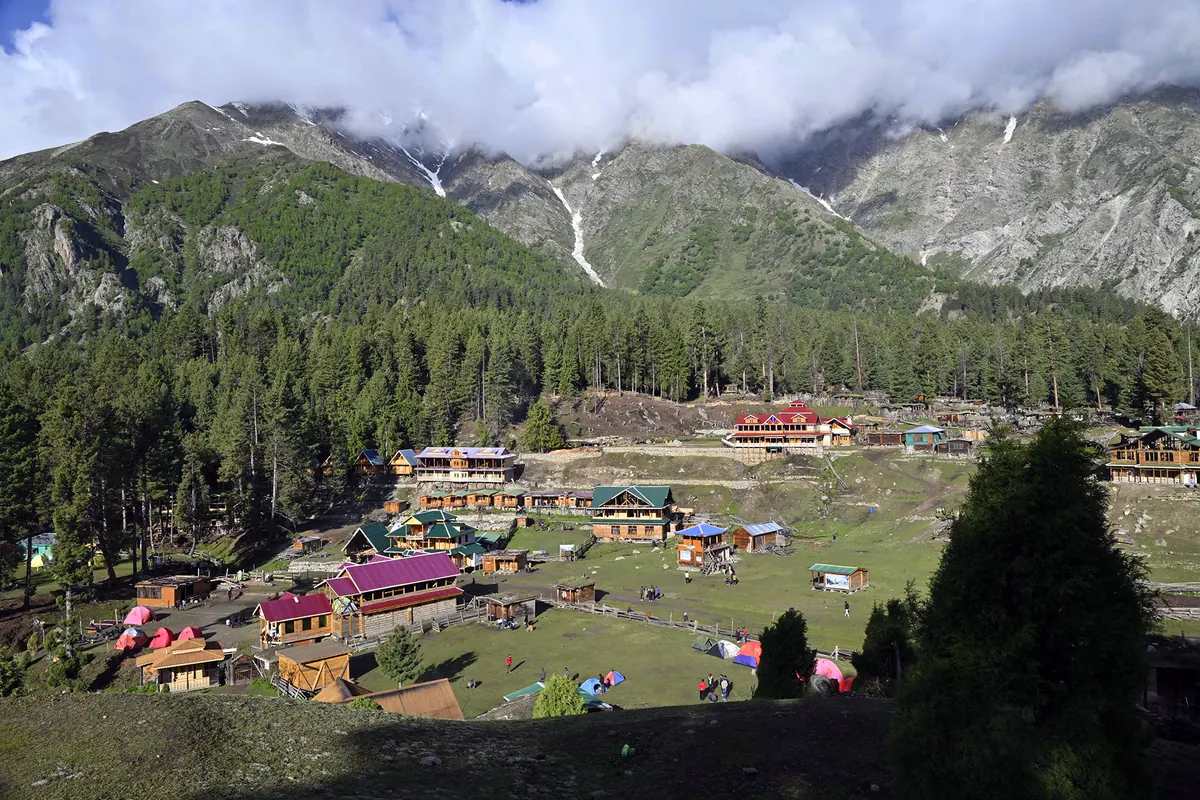
Book cottages ahead in June, July and August, when the meadow is at its busiest. If you want the under-canvas version or a gentler, family-paced trip, we run those as separate options: our Fairy Meadows camping tour puts you in a tent on the grass, and the family version uses ponies and an easier schedule for children and older travellers.
Trekking on to Nanga Parbat base camp
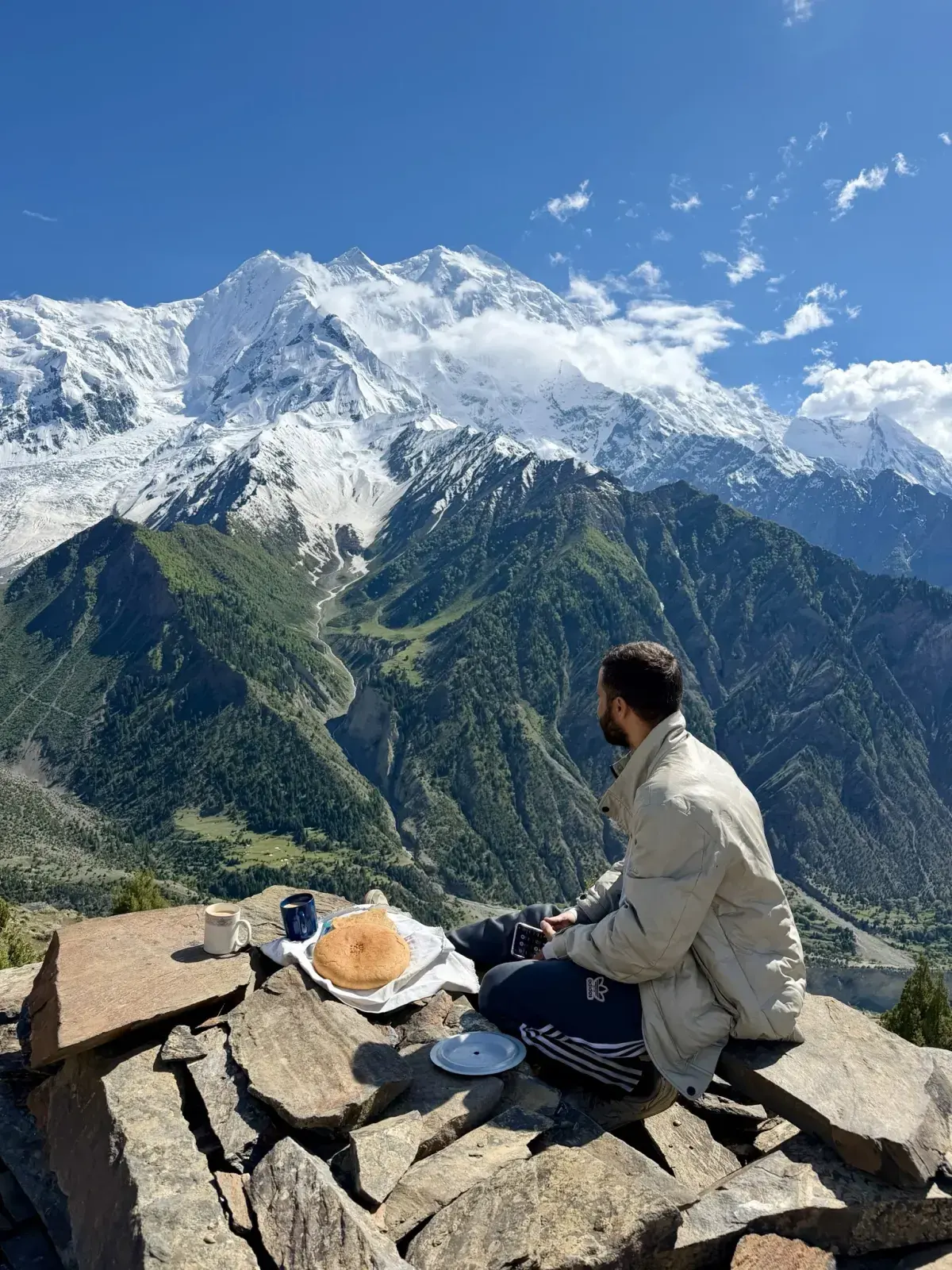
Most people treat Fairy Meadows as the destination, but the meadow is really the trailhead for one of the finest short treks in Pakistan: the walk to Nanga Parbat base camp on the Raikot face. It is what turns a two-night stay into a proper mountain trip.
From the meadow it is a 20-minute stroll to the little Reflection Lake, where on a still morning the whole mountain mirrors in the water. Carry on and you reach Beyal Camp at about 3,500 m in 2 to 3 hours, the last outpost of trees and teahouses. Beyond Beyal the forest gives way to moraine and the Nanga Parbat base camp and viewpoint at roughly 3,850 to 3,950 m, about 3 hours further on, right beneath the Raikot Glacier and the sweep of the north face. The full outing from Fairy Meadows to base camp and back is about 8 to 10 km and 6 to 8 hours, so it is a long but non-technical day for a fit walker. This is the same face that serious climbers use for the Nanga Parbat expedition, and standing at its foot is the closest most travellers will ever get to an eight-thousander.
Permits, NOC and guides: what you actually need
This is the part most guides online skip, so here is the current position for 2026. Rules do change, so confirm your own case within a month of travelling.
- Pakistani nationals on holiday: no NOC or trekking permit is needed for Fairy Meadows. You simply register at the Raikot checkpoint.
- Foreign tourists: there is no special trekking permit for Fairy Meadows itself, but travelling with a government-licensed guide or operator is expected, and your operator provides the visa invitation letter. Fairy Meadows is an open zone, unlike the restricted areas near the borders.
- The exceptions: certain nationalities and anyone on a work visa can be asked for a No Objection Certificate, which can take several weeks to process. If that might apply to you, start early and let your operator file it.
If your trip is part of a wider first visit, our 2026 guide to visiting Pakistan covers the e-Visa rules and timing in full.
Altitude, signal and cash: the practical bits
A short logistics cheat-sheet that competitors rarely give you:
- Altitude: at 3,300 m and climbing to nearly 4,000 m at base camp, mild altitude symptoms are common. Climb slowly, drink plenty of water, and if base camp is your goal, spend a night at Fairy Meadows first to acclimatise.
- Mobile signal: only SCOM works up here, and even that is patchy. Jazz, Zong and Telenor all die at Raikot Bridge. Buy a SCOM SIM in Gilgit with your passport if staying connected matters, and warn people at home you will be offline.
- Cash: there are no ATMs and no card machines past Chilas or Gilgit. Carry enough rupees for the whole trip plus a buffer.
- Power and water: charge everything before you arrive, bring a power bank, and treat or boil water rather than drinking straight from the stream.
- If the road closes: landslides do block the Karakoram Highway after heavy rain, so build a spare day into any Fairy Meadows plan rather than booking a tight onward flight.
How many days, and is Fairy Meadows open now?
Give it three days as a minimum: one long travel day up, a full day at the meadow (with the reflection lake and a walk toward Beyal), and a day back down. Four or five days lets you add the base camp trek without rushing, and it is the length we recommend. As for whether it is open, that depends on the season: the jeep track and cottages run roughly May to October and are firmly closed through winter, so plan for the summer window and check current conditions before you set off.
The short version
Fairy Meadows is easier to reach than its reputation suggests and more beautiful than the photos let on. Aim for June to September, break the drive with a night near Chilas, let the union drivers handle the famous jeep road, and give yourself an extra day for the walk to Nanga Parbat base camp. Get those decisions right and it becomes the highlight of a northern Pakistan trip rather than just a stop on it. When you are ready to turn this into real dates, that is exactly what we do.
Frequently asked questions about Fairy Meadows
Where is Fairy Meadows and how do you get there?
Fairy Meadows sits at about 3,300 metres in the Diamer District of Gilgit-Baltistan, on the north face of Nanga Parbat, roughly 400 to 490 km north of Islamabad. You reach it in three stages. First, drive the Karakoram Highway to Raikot Bridge, a long day usually broken with a night near Chilas. At the bridge the tarmac ends and you switch to a local union 4x4 jeep for the 15 to 16 km, hour-and-a-half climb to Tato village. From Tato it is a 5 km trek on foot, about 3 to 4 hours uphill through pine forest, to the meadow itself. You cannot drive your own car past Raikot Bridge; only the union jeeps are allowed on the track. Flying Islamabad to Gilgit and driving the 77 km south to Raikot saves almost two days if the weather cooperates.
How dangerous is the Fairy Meadows jeep road?
The Raikot jeep track is often called one of the world's most dangerous roads, and the setting is genuinely dramatic: a narrow, unpaved shelf with no guardrails and a steep drop on the open side. That said, the day-to-day reality is far calmer than the headlines. The road is run by a union of local drivers who have worked it for decades, they drive slowly and know every passing point, and their safety record with visitors is good. The real discomfort is vertigo and motion sickness rather than any likelihood of a crash, so sit on the inside, keep your eyes up the slope, and tell your driver if you are nervous. The one genuine mistake is trying to drive it yourself in a rented vehicle, which is both against the union rules and unwise. Relax and let the professionals handle it.
What is the best time to visit Fairy Meadows?
Fairy Meadows is open roughly from May to October and closed and snowbound the rest of the year. The peak window is June and July, when the weather is warmest and the clear views of Nanga Parbat are most reliable, which also makes them the busiest weeks. May and September are the quiet sweet spot: fewer people, crisp clear air and superb stargazing, though nights are colder and early May can still carry snow. August brings monsoon moisture and cloudier mornings, along with a little landslide risk on the approach roads, so keep your dates flexible if you travel then. October offers autumn colour but cold nights and closing facilities. Whichever month you choose, the altitude means nights drop close to freezing even in high summer, so a warm jacket and layers are essential year-round.
How much does a Fairy Meadows trip cost?
It depends on whether you assemble it yourself or book a package. The fixed union jeep from Raikot Bridge and back runs about PKR 16,000 to 20,000 per vehicle, shared between five or six people. Cottages cost roughly PKR 2,000 to 5,000 a night and food PKR 1,500 to 2,500 per person per day, so a budget domestic trip run independently lands around PKR 25,000 to 35,000 per person for a few days. Guided domestic packages from Islamabad run roughly PKR 25,000 to 85,000 for five days depending on comfort. For foreign visitors, who need a licensed guide anyway, a nine-day Fairy Meadows and Nanga Parbat base camp trek typically costs USD 750 to 1,190. Our own guided Fairy Meadows tour starts at USD 800 with the jeep and cottage included. Carry cash, because there are no ATMs past Chilas or Gilgit.
Can you trek from Fairy Meadows to Nanga Parbat base camp?
Yes, and it is the highlight for anyone with an extra day. From Fairy Meadows it is a 20-minute walk to the Reflection Lake, then 2 to 3 hours on to Beyal Camp at about 3,500 metres, the last stand of trees and teahouses. Beyond Beyal the trail crosses moraine to the Nanga Parbat base camp and viewpoint at roughly 3,850 to 3,950 metres, about 3 more hours, directly beneath the Raikot Glacier and the mountain's north face. The full round trip from Fairy Meadows is about 8 to 10 km and 6 to 8 hours, non-technical but long, so a reasonable level of fitness helps. Because you climb close to 4,000 metres, spend a night at Fairy Meadows first to acclimatise, start early, and carry water and warm layers. It is the closest most travellers ever get to the foot of an eight-thousander.
Do foreigners need a permit or NOC for Fairy Meadows?
For most foreign tourists there is no special trekking permit for Fairy Meadows, because it is an open zone inside Nanga Parbat National Park rather than a restricted border area. What is expected is that you travel with a government-licensed guide or operator, who also provides the visa invitation letter you need for the e-Visa. Pakistani nationals on holiday need nothing beyond registering at the Raikot checkpoint. The exceptions are certain nationalities and anyone travelling on a work visa, who can be asked for a No Objection Certificate that takes several weeks to process. Because these rules shift, confirm your own situation within a month of travelling and let your operator handle any paperwork. If this is part of a first trip to Pakistan, our separate guide to the 2026 e-Visa rules covers the visa side in detail.
Where do you stay at Fairy Meadows, and is there electricity or phone signal?
Accommodation is a handful of seasonal wooden cottages and campsites among the trees, all simple. Named lodges like Raikot Serai and Fairy Meadows Cottages offer basic rooms with beds and blankets, and some have a mountain view from the porch; camping, in your own or a provided tent, is the better choice for clear nights and early starts. Book cottages ahead in the busy months of June to August. Facilities are basic by design: power comes from solar panels and the occasional generator, so it is intermittent and mostly for lights rather than charging devices overnight, and hot water is limited. Phone signal is the big one to plan for, since only SCOM works up here and even that is patchy. Jazz, Zong and Telenor all cut out at Raikot Bridge, so buy a SCOM SIM in Gilgit or simply enjoy being unreachable for a couple of days.
How many days do you need, and is Fairy Meadows open now?
Three days is the practical minimum: a long travel day up to the meadow, a full day there for the reflection lake and a walk toward Beyal, and a day back down to the Karakoram Highway. Four or five days is better, because it lets you add the Nanga Parbat base camp trek without rushing and leaves a buffer in case a landslide delays the road. As for whether it is open, that is entirely seasonal. The jeep track and the cottages run from roughly May or June until late September or October, and through winter the meadow is snowbound with no vehicle access at all. If you are planning outside those months, it will be closed, so aim for the summer window and check current road and weather conditions shortly before you travel.
Ready for Your Next Adventure?
Join our community of explorers and discover the journey of a lifetime. Our expert team is ready to help you plan your perfect expedition.